Germany's games industry is growing — and under considerable pressure at the same time. The number of games companies in the core market rose from 524 to 948 between 2018 and 2024. Yet of every 100 euros spent on games in Germany, only 5.50 euros stay with German companies, as the latest industry study by the German games industry association game and Goldmedia shows. Anyone who wants to compete internationally under these conditions has to deliver content that holds its own against far larger productions — with leaner teams and tighter budgets.
This is exactly where the debate about generative AI in game production picks up — though not in the way many headlines suggest. The question is no longer whether AI can generate a 3D model in seconds. It can. The real question is: are the results consistent enough to actually shorten production time, or do they merely shift the work to another part of the pipeline?
Sobering numbers, useful signal
The latest edition of GDC's State of the Game Industry report paints a nuanced picture: 36 percent of the more than 2,300 industry professionals surveyed use generative AI tools in their work — primarily for research and brainstorming (81 percent), everyday tasks and coding assistance (47 percent each), and prototyping (35 percent). Asset generation itself trails well behind at 19 percent. At the same time, 52 percent of respondents rate generative AI's impact on the industry as negative — more than ever before.
This scepticism is not a contradiction of growing adoption; it is a finding in its own right: there is no shortage of tools that produce content quickly. Tools whose output meets the quality bar of a finished production are rare. The benchmark is shifting from raw generation speed to how quickly a generated asset can actually be used in the pipeline, without rework, without style corrections, without detours.
The real problem: style drift across assets
A single good model is worth little to a production if the twentieth model no longer matches the first. Art direction drift — creeping style deviations across a series of assets — is one of the most common reasons AI-generated content ends up being reworked or discarded in practice. The time saved in generation is then eaten up elsewhere.
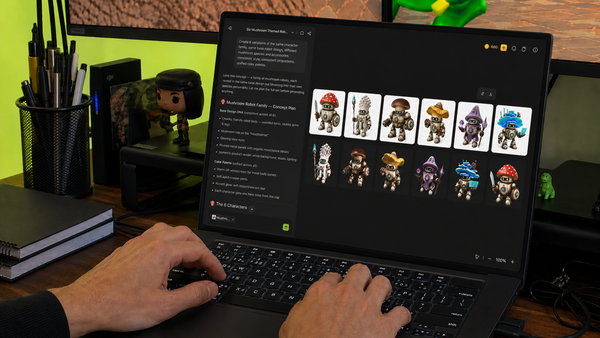
Meshy's answer is the Meshy 3D Agent. According to the company, the first fully conversational AI agent for 3D creation. Instead of firing off individual prompts, users develop concepts in a dialogue with the agent, refine them, and generate entire style-consistent asset sets in one continuous workflow. The starting point can be a text description, a reference photo, a sketch or a rough idea.
For use in existing pipelines, the platform exports to eight standard formats (FBX, OBJ, GLB, USDZ, STL, BLEND, 3MF and DXF), covering the common environments from Unity and Unreal Engine to Godot, Blender, Maya, 3ds Max and Roblox. Rigging and animating generated characters is now also possible directly in the chat. The result is game-ready assets that can be dropped straight into engines such as Unity or Unreal. More than twelve million registered users work with the platform, according to the company.
Where AI fits into game production today
In practice, conversational AI is currently finding its place mainly in the early phases of production: concept exploration, blockouts, secondary props and prototyping get faster — while hero assets and the final creative decisions stay with the teams. The point is not to replace artists, but to reduce the repetitive share of the work.
For studios that have to do more with fewer resources, which describes a large part of the German industry - the competitive advantage of generative AI ultimately does not lie in generating more assets. It lies in generating consistent assets that let teams build faster without compromising on quality.
About Meshy AIMeshy AI develops an AI platform for 3D creation, including text-to-3D, image-to-3D and the Meshy 3D Agent. More than twelve million registered users worldwide work with the platform. The company recently closed a Series B financing round of around 400 million US dollars and is valued at 1.5 billion US dollars. More information: meshy.ai