Game development is a complex process. Games rarely look the same during development as they do at the end. To shine a light on these technical, sometimes messy states, In Development interviews studios specifically about early stages of their development cycle: By putting pictures of unfinished games into the spotlight.


Who are you and what are you making?

Stijn Verstraete, Lead 3D Artist: We are Torpor Games, a game dev studio from Berlin. The Conformist is an upcoming semi-sandbox narrative role-playing game currently in development. Players guide a propagandist working for the government of Sordland, navigating the harsh political environment in the capital after a civil war and discovering their own path.

Set in the Suzerain universe, Torpor Games’ 2020 debut title, players step into the city of Holsord, discovering the country of Sordland and its people caught within the turbulence of a newly established military government under President Tarquin Soll. Players must manage their obligations to their superiors, their ambitions, and protect their family whilst avoiding the scrutiny of the state – or aiding the resistance factions against them.

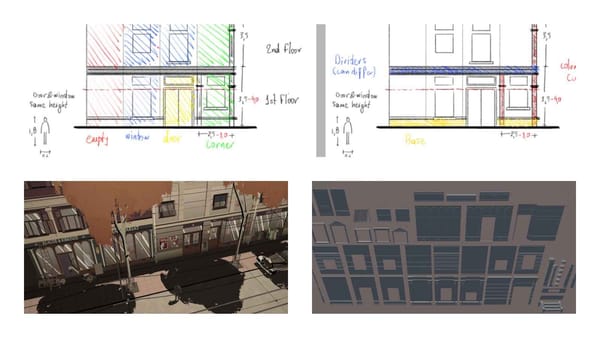
Screenshot 1: The modular building kit (Torpor Games)

What can we see here?

In the first screenshot, we showcase our modular building set—a toolkit we've developed to efficiently construct parts of our game world. The second screenshot displays this set in action within the game's environment, demonstrating its potential even as a work in progress. The third image features an architectural guide we've created to maintain consistent dimensions across all our structures.

Screenshot 2: The set from Screenshot 1 in the game's environment (Torpor Games)

Why did you choose this process to show us?

In developing The Conformist, we're building an expansive world consisting of three distinct districts. To manage this scale efficiently, modularity is key. Instead of modelling each building individually, we're focusing on creating modular "sets" in various architectural styles. The screenshots we've shared showcase our first set. By precisely defining the dimensions for every piece, we can easily swap components to create a wide variety of buildings that remain consistent in style. This approach allows us to efficiently populate our game world while maintaining aesthetic cohesion.

Screenshot 3: Architectural guide for consistent dimensions across all structures (Torpor Games)

Is there anything special you want people to learn from it?

Absolutely! We want to highlight the importance of modularity and thorough planning. Without our modular set, developing this game would be unfeasible. By defining dimensions in advance, we ensure that all future assets are compatible with our existing 3D models. This approach allows us to efficiently create a cohesive game world where new elements seamlessly integrate with what we've already built.

Share this post

Written by

Pascal Wagner
Pascal Wagner is Chief of Relations of GamesMarket and Senior Editor specialised in indie studios, politics, funding and academic coverage.