StarVaders

– 3 min read

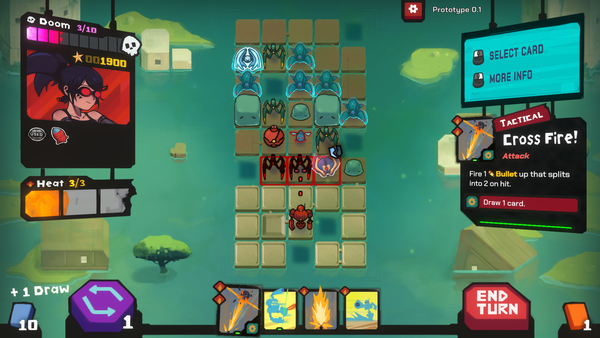
With so many roguelike deck-building games out there, it's hard for a game in this genre to stand out. However, StarVaders achieves this with its clever design, variety, and colourful presentation. It offers a wild mix of mecha roguelike deck-building and tactical shoot-'em-up.
In StarVaders, players must defend Earth from alien attackers by operating mecha. This tactical grid-based strategy game combines deck-building elements with roguelike progression. Each run consists of three acts, each comprising several increasingly difficult battles/levels, random encounters and boss fights. Enemies appear at the top of the grid-based playing field on each level and advance downwards with each turn. When they reach the bottom rows, they generate 'Doom', resulting in a 'game over' once a certain Doom level is reached. Therefore, players must try to defeat the enemies tactically. This starts off easily but becomes more challenging as obstacles are introduced, and the enemies start to fight back.
Players control a mech directly on the playing field, where movement and positioning are crucial. There are three playable mechs: Gunner (direct firepower; resource: heat); Stinger (movement and targeted attacks; resource: Energy); and Keeper (tactical control; resource: Mana). Each has its own play style and resource system. There are also ten unlockable pilots, each with their own unique starting artefacts and card sets, which provide additional variety and replay value. When an opponent hits the mech, the player does not lose health; instead, a useless scrap/junk card is shuffled into the deck, which may jam it up. However, the outcome of the game is decided solely by the Doom counter.
Turn-based battles are fought using cards that trigger various actions, such as attacks, tactical moves, and movement around the playing field. At the start of each round, new cards are drawn and played cards are placed in the discard pile. Once this pile is empty, it is refilled from the draw pile. There are also very helpful (but limited) Chrono Tokens, which allow players to reset moves and correct mistakes without having to start a new game (especially when RNG strikes again). Players can also reroll rewards, restock the shop or reroll the boss encounter. Visually, the game features a clear, retro-inspired, exaggerated, colourful comic-book style.
The runs are shorter than in other deck builders, usually lasting less than an hour. This encourages players to adopt fast and focused tactics. This means that every decision a player makes when building their deck is important. During a run, players receive rewards for each battle, including new cards for their deck, upgrades for existing cards, and artefacts that give their entire deck special effects. The cards received depend on the chosen mech and pilot. Each mech comes with its own set of cards and mechanics, while the pilot contributes additional abilities and strategic modifications. Card upgrades and artefacts enable players to build powerful synergies and combos that grow stronger as the run progresses. New mechs, pilots and neutral card groups are gradually unlocked by achieving certain objectives, defeating (creatively designed) bosses or completing campaigns with specific characters, and so on. The variety of card pools and play styles for each pilot and mech increases the strategic depth and replay value.
There are no permanent upgrades between runs (meta progression), but rather a constant expansion of strategic diversity. After each completed run, new encounters and bosses are unlocked as timeline divergences. These divergences ensure that the structure of the act, enemy composition and boss fights change from run to run. Overall, it's a game that falls into the 'easy to learn, hard to master' category – the developers have tried to translate 'complexity into spatial understanding', keeping the quantity of numbers fairly low. There are over 400 cards and artefacts in total.
StarVaders was released for PC on 30 April 2025 for €22. It was developed by the small Montreal-based indie studio Pengonauts, with Eddie Cai as lead designer and Hansen Liu as lead programmer. This is the studio's first game. It is published by Playworks and Joystick Ventures.
StarVaders is a real highlight in the crowded roguelike deck-building genre. It offers fast-paced runs, plenty of variety, tactical grid-based challenges, powerful synergies, and creative yet easy-to-understand mechanics.