Mattel Acquires Full Ownership of Mattel16, Announces New Games and Content For Roblox And Fortnite
Mattel has purchased its partner NetEase's 50 per cent stake in their joint mobile gaming studio Mattel163 for $159 million. The deal strengthens Mattel's digital and gaming strategy, which is based on three pillars.

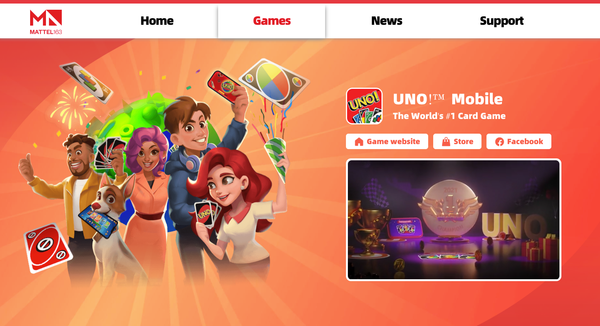
According to company information, Mattel163 has released four games based on Mattel IPs since its founding in 2017. These are Uno!, Uno Wonder, Phase 10, and Skip Bo, which together have reached around 20 million users per month and 550 million downloads worldwide.
Mattel intends to continue operating the digital business on its own in the future. To this end, the US toy company is purchasing its joint venture partner NetEase's 50% stake in Mattel163. The price is £159 million, valuing the studio at £318 million.
“Our vision is to extend physical play to the virtual world by creating digital experiences and games based on Mattel IP that drive sustained engagement for fans of all ages. Acquiring full control of Mattel163 does exactly that,” says Ynon Kreiz, Chairman and CEO of Mattel. “It will play an important role in our digital strategy and significantly enhance our capabilities in self-publishing. The Mattel163 team has done remarkably well building this business from the ground up and we look forward to welcoming them on board. Our portfolio of iconic brands lends itself perfectly to the digital world and the acquisition will strengthen our position and accelerate our presence in a large, high-growth market.”
Mattel itself wants to conquer the digital market with a three-pillar strategy. On the one hand, it will continue to focus on licensing partnerships with publishers such as Take-Two, Microsoft Xbox, SuperCell, Netflix and Apple Arcade. On the other hand, it also wants to serve creator platforms such as Roblox and Fortnite in the future. The third pillar is the self-publishing of original mobile games. Two titles are scheduled for release in 2026.
Like almost all major toy manufacturers, Mattel invested heavily in gaming in the 1990s and operated its own publishing company, Mattel Interactive, which even had a office in Germany. However, this was renamed (in German) TLC – The Learning Company in early 2001 after Mattel sold its interactive division to Gore Technology Group in autumn 2000.
Written by