Doom: The Dark Ages

– 4 min read

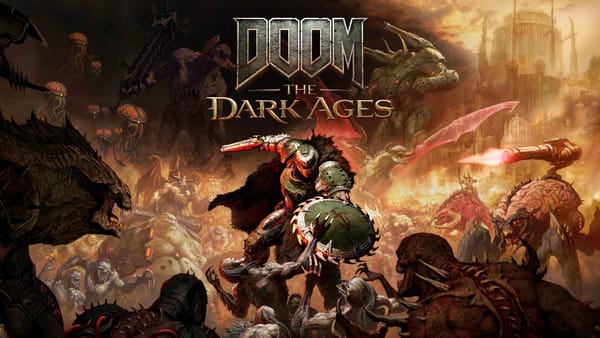
Cult developer id Software is back with Doom: The Dark Ages, the most ambitious Doom game yet. It will be different from Doom Eternal in terms of gameplay and will focus exclusively on single player.
It's the prequel to Doom (2016), which focused on traditional run-and-gun action, while Doom Eternal (2020) turned the Slayer into a super-fast, acrobatic fighter jet - something not all fans of the series appreciated. In Doom: The Dark Ages, the shooter gameplay will change again. This time, the Slayer should feel like a down-to-earth iron tank with a lot of power. It's all about standing strong and fighting. New tools in the loadout include the Shield Saw, which can block incoming fire, attack enemies from a distance, and deflect incoming projectiles that are highlighted in a different colour.
There are also three new melee weapons - a spiked flail, an electric gauntlet and a fierce spiked mace - all with their own combos and upgrade options. Of course, there are still the melee glory kills, which are much more dynamic this time around. Of course, there are also plenty of weapons to choose from, including a double-barrelled shotgun, an energy-powered weapon that spits out stun shots, and a machine gun that fires high-speed rounds by shattering skulls. Together, they make for a unique blend of melee and ranged combat, with the Slayer stomping right into the action.
Yes, the gameplay changes from Doom and Doom: Eternal might sound particularly significant, but no, it is still Doom and it plays like Doom and most of the combat is still arena-based. It is also very fast with the shield rush, although the acrobatic elements of Doom: Eternal have been removed. But this time around, there's an even stronger and more dynamic shift between ranged and melee combat, more ways to get health and ammo, as well as crowd control options with the shield saw, although you do lose your parrying abilities when you throw away your shield.
The glory kills are even more dynamic this time around, as are the enemy damage models, which allow you to rip the demonic flesh from their bones with greater precision. But there are many more nuances to combat, such as overloading energy shields or making metal glow red-hot before smashing it with your shield, as well as options for upgrading weapons and shields, and customising the playstyle. id Software really goes all out with the shooter elements here... And yet it's still accessible, thanks to the fact that - apart from the usual difficulty levels - you can manually adjust many aspects, such as how long the parry window should be, how much damage enemies do to the player and vice versa, how markers are placed in the game world, or how many pick-ups appear. What id Software has come up with here in terms of gameplay modifiers for single-player shooters to improve accessibility is exemplary.
Speaking of stomping. In some levels it's possible to pilot a giant Atlan, a colossal mech built to take on super-sized enemies. Plus, there is a cybernetic dragon, complete with mounted Gatling guns, that the Slayer can ride to take the fight to the skies. With 22 levels, it also features the most extensive single-player campaign in the Doom series to date, with plenty of secrets and collectibles to be found throughout. The levels cover both dark fantasy and sci-fi worlds, including four rides on the versatile Dragon (in regular levels) and three levels in the Atlan Mech, which turn the player into a sort of Godzilla. Doom and Doom Eternal each contained 13 levels. But it's not just more levels, they're also bigger, more varied, beautifully designed and, together with the excellent mini-map, invite players to explore. And there are more different enemies to fight at all. All this means that the shooter gameplay, thanks in part to many creative weapon upgrades, offers a surprising and outstanding amount of gameplay variety. Rarely has a shooter been so creative.
But combat is only one of the three pillars of Doom: The Dark Ages. The second is exploration. Much larger levels, which turn out to be small open worlds or sandboxes, invite players to explore them in all their hellish beauty. Players have never had so much freedom in the series. The Shield Saw plays an important role here, as it can be used to overcome obstacles or destroy objects in order to find loot, upgrades and secrets. Those not interested in exploring can simply take the direct route. As the game is completely free of multiplayer, all resources are focused on the single player, making the story the third pillar of the game. It will be much more accessible because the story beats have been taken out of the codex and put into cinematic, gritty and serious cutscenes.
Technically speaking, this shooter has it all. Powered by idTech 8, the game is based entirely on ray tracing, so the PC version requires a hardware ray tracing-capable GPU. It also supports path tracing, which of course requires more power. Despite its visual quality, the game is designed to run at 60fps on all platforms. The game feels buttery smooth, has no problems with traversal stuttering and looks great. The traversal, on the other hand, is like in Indiana Jones and the Great Circle (a modified version of idTech 7), which was also added in a later patch and will look even better.
Doom: The Dark Ages (Bethesda) will be released on PC (Battle.net, Steam, Windows Store), PlayStation 5 and Xbox Series X|S on 15 May 2025. It will also be included in select Game Pass tiers from Day One. The Premium Edition includes up to two days Advanced Access, a campaign DLC, a digital artbook and soundtrack, and a skin pack. Plaion distributes the console editions on the German market (Standard Edition and Premium Edition).
Doom: The Dark Ages has it all. The shooter features unique and versatile combat, exploration and cutting-edge technology. It already looks like one of the best shooters of recent years.