In their weekly interview series Womenize! features inspirational, diverse people who work in the games and tech industry, to share their experiences, give valuable advice and talk about their projects. In cooperation with Womenize! and Madeleine Egger, GamesMarkt is republishing these inspirations.
Womenize! – Inspiring Stories is our weekly series featuring inspirational individuals from games and tech. For this edition, we talked to Sima Iurova, Senior Game Designer at Wooga. She speaks about how her scientific background, combined with player testing and real-world constraints, influences the way she designs and refines interactive storytelling in games. Read more about Sima here:
Hi Sima! You started with a Master’s in Chemistry and Chemical Engineering before moving into game design. How does your scientific and technical training influence your approach to designing interactive stories and player experiences?
People are often a bit surprised when they hear that I came to games after a scientific and technical education and research experience. My specialization sat at the intersection of chemistry and physics, and I think that kind of background can be very useful in game design — really, the same is true for technical education more broadly.
What it gives you is a certain way of approaching problems. In science, you form hypotheses, test them, look at the results, and adjust your approach. It also teaches you to orient yourself around data and to feel comfortable with statistics, analytics, and evidence-based decisions. Game design works in a very similar way.
A big part of a game designer’s job is looking at data and using it to balance the experience. That applies to all kinds of systems in a game, and narrative is no exception. Narrative can also be balanced and refined through iteration. Pacing, information flow, and progression all affect how players move through the experience.
One thing I would say to people starting out is not to get discouraged if it takes time to find your first role.
You’ve worked on both educational projects and narrative-driven mobile games. How has your experience across these different types of projects shaped the way you approach interactive storytelling?
My path was a bit circular. I started with interactive story projects, then worked on an educational project, and later returned to narrative-driven games. Today I work in that space on June’s Journey.
That educational project was Zebrainy, a children’s learning platform built around the adventures of one central character in a larger story world. So even though the individual games were educational, they still had to feel like part of the same world and character-driven experience. My role there focused on rapid prototyping — designing small hyper-casual learning mini-games, often within just a couple of weeks.
One of the most valuable parts of that setup was frequent playtesting. We could try out a mechanic quickly and then watch groups of children in a kindergarten play it. The project also gave us access to input from an educational specialist, which was very helpful when shaping and evaluating the games.
That was very revealing. Things that felt obvious during development sometimes turned out to be confusing, ignored, or understood in a completely different way. It teaches you very quickly that what a designer wants to communicate and what players actually take away are not always the same thing.
That experience shaped how I think about interactive storytelling as well. It made me much more attentive to player perception — how people read an interaction, what feels clear, what gets missed, and what actually feels meaningful.
You can see this especially clearly in live narrative games that use player choices. A choice may seem perfectly logical or emotionally strong on paper, but once the game is live, the data sometimes shows something very different. Things like wording, framing, or frequency can have a real impact on how players respond.
That taught me not to trust only my own sense of what seems clear or effective. One of the valuable things about live free-to-play games is that you can test your hypotheses against real player data, see what actually works and what does not, and then bring that back to the writers and the team to refine the experience over time.
Reflecting on your journey, what advice would you give to aspiring game designers, especially when it comes to balancing creativity with constraints like monetization and user attention?
One thing I would say to people starting out is not to get discouraged if it takes time to find your first role. The industry is very competitive, especially right now.
What helped me early on was simply making things and gaining hands-on experience wherever I could. My first larger personal project was a small first-person 3D narrative game I built in Valve’s Hammer Editor, a level design tool originally used for Source engine games. It followed a scientist living alone on top of a mountain and gradually turned into a psychological horror as he descended.
One of the valuable things about live free-to-play games is that you can test your hypotheses against real player data, see what actually works and what does not.
The project was tiny and not something that could ever be commercialized, but it gave me something concrete to talk about in my first job interviews even though I did not have formal training in game design. Working on it also taught me a lot about level design, triggers, and environmental storytelling.
So my advice would be: make your own projects, join game jams or hackathons, and look for ways to get practical experience. Even small projects teach you a lot — not only technical skills, but also how quickly ideas can change once you start turning them into something playable.
You can start with something that feels very clear on paper, but as soon as other people interact with it, it usually needs to change. The same thing happens in professional development, just on a larger scale.
Constraints like monetization, technical limits, or production realities are not outside the design, and they are not the opposite of creativity. They are part of the system you are designing for. The challenge is to shape an idea so it still feels meaningful within those limits.
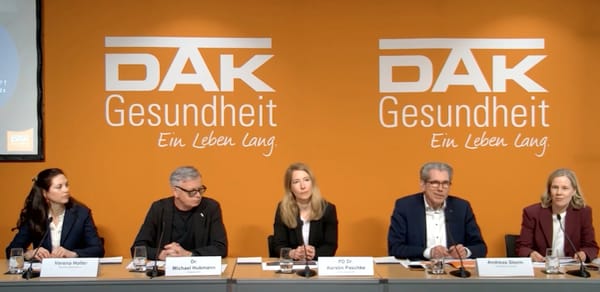
Verena Holler (Founder and Speaker ‘Smarter Start at 14’ parents' initiative), Dr Michael Hubmann (President of the Professional Association of Paediatricians), Dr Kerstin Paschke (Principal researcher and medical director of the German Centre for Addiction Issues in Children and Adolescents (DZSKJ) at the UKE), Andreas Storm (CEO DAK) and Julia Rasche (Head of Press and Political Communications & Press Officer) | Screenshot press conference