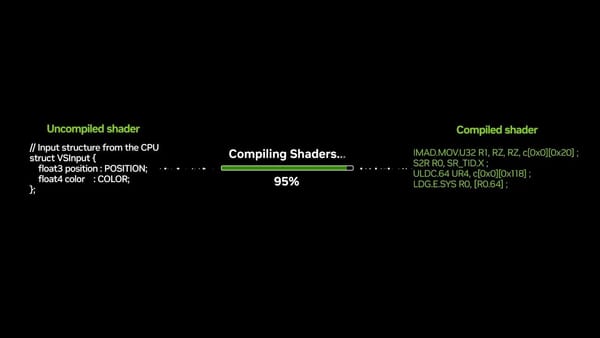
Shader compilation in modern games is a source of frustration for many players. During the initial launch, there can be waiting times of several minutes for shader pre-compilation, followed by another round of shader compilation after driver updates. This interrupts what should be a quick start to the game, but ensures that gameplay runs more smoothly once underway. Then there's the shader stutter within the games themselves, usually caused by shaders being compiled on the fly while playing, which leads to brief freezes or stuttering. This issue is particularly prevalent with modern APIs such as DirectX 12 or Vulkan, since games do not pre-compile all shaders but instead load them as new effects are required.
Microsoft has teamed up with AMD, Intel and Nvidia to address these issues. Specifically, they aim to further develop shader processing. While these issues are usually caused by shader compilation at runtime, Microsoft's Advanced Shader Delivery (ASD) technology eliminates this bottleneck by providing pre-compiled shaders as soon as the game is downloaded (Microsoft Dev Blog).
Henry Lin, Director of Product Management, Gaming & AI at Nvidia: "To eliminate the shader-related stutters and load times that have plagued gamers for years, Nvidia is working closely with Microsoft on launching Advanced Shader Delivery for GeForce RTX consumers later this year."
AMD: "First made available on the AMD Ryzen Z Series processor-powered Xbox ROG Ally and Ally X handheld gaming devices, Advanced Shader Delivery addresses longstanding issues of shader compilation times and in-game stutter by enabling gamers to download fully compiled shaders tailored for their hardware."
Lisa Pearce - Corporate Vice President, Software Group, Intel: "Intel is committed to solving shader compilation challenges on PC to improve the overall gaming experience. Microsoft Advanced Shader Delivery is a critical step toward reducing shader load times and compilation stutters, and Intel is pleased to release drivers supporting this feature on our Lunar Lake and Panther Lake platforms."
Last but not least, the standardisation of hardware-accelerated AI via DirectX was announced. This collaboration will boost GPU efficiency, ensure smoother gameplay by eliminating context switching and provide a unified workflow for a large proportion of developers. Building on the introduction of support for Cooperative Vector last summer, Microsoft intends to release DirectX Linear Algebra and the DirectX Compute Graph Compiler, which will accelerate the entire gaming pipeline.
GamesMarkt Daily Newsletter
Sign up to receive the free daily newsletter about the Games Industry in GSA, Europe and beyond.
No spam. Unsubscribe anytime.