Factorio: Space Age

– 5 min read

Whereas in Factorio you only had to exploit one planet and turn it into a massive automatized factory, in Factorio: Space Age you can actually exploit four more planets. The scope of the expansion is more like a true sequel. So the game that started the automation genre is getting bigger. Wube Software is also sticking to its "no-sale policy".
Factorio can be considered the father of factory automation games such as Satisfactory, Dyson Sphere Program or shapez, even though it incorporates parts of Anno, Dwarf Fortress, RimWorld, Simcity and Transport Tycoon. But anything to do with conveyor belts probably goes back to Factorio. For those unfamiliar with it, Factorio is a game where you crash on a planet, either alone or in cooperative multiplayer. You collect and process all kinds of resources to build a rocket to leave the planet - at first you mine resources by hand, but this is quickly replaced by industrial automation with conveyor belts and later oil refining with pipes, nuclear power and laser weapons. This often results in gigantic factories producing intermediate and final products and cargo trains run between the factories, while the planet's fauna becomes more aggressive and attacks regularly due to environmental pollution. Factorio is therefore a mixture of simulation, RTS, building, management and tower defence. It uses 2D graphics (45-degree angle), is based on a custom game engine, and allows modding.
Development of the outstanding game began in May 2012, when two programmers set up a 'garage company' that would later (in September 2014) become Wube Software (Prague, Czech Republic). Wube is an abbreviation of Wszystko będzie, which means 'everything will be done eventually'. The game was initially crowdfunded on Indiegogo in February 2013. Things started slowly with a trailer in May 2014, followed by the Steam Early Access launch in February 2016. More than four years later, in August 2020, the full version was released. In October 2022, the game was ported to Switch. After that, the developers decided to expand Factorio rather than make a sequel, even though the scope of Space Age would have been sufficient for a sequel.
To date, Factorio has sold over 3.5 million copies on PC, and the team has grown to around 30 full-time employees and contributors from around the world. The company has also decided against taking part in sales promotions or selling the game at a discount. In the beginning, the game cost €20. Since the beginning of Early Access, the game has been sold for $30. In January 2023, the team announced not a price reduction, but an increase due to inflation since 2016. The price went from $30 to $35, the euro price is €32. By the way, Factorio: Space Age will cost the same as the main game.
"Not having a sale ever is part of our philosophy. In short term, they are good and bring extra money, but we are targeting long term. I believe that searching for sales is wasted time, and people should decide on the price and value, but putting option of wasting time to search for deals or waiting seems like bad part of the equation. As an example I would like to mention Minecraft. I'm not aware of any sale of it." - Co-founder Michal Kovarik aka Kovarex in a forum post in May 2016
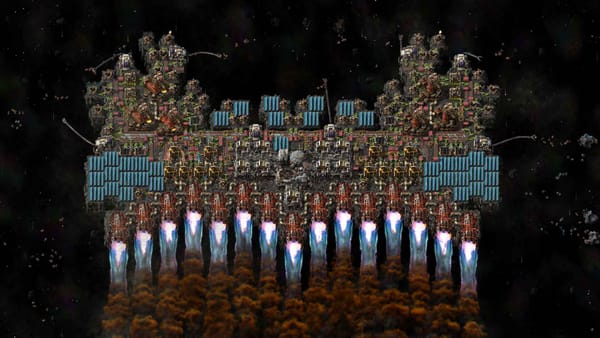
And now for the expansion. In Factorio: Space Age, you won't just be exploiting one planet, you'll be exploiting four new planets, each with its own challenges and quirks. Instead of sending one rocket into space, players will have to send many to build a large space platform - although in Space Age it will be much cheaper to build and launch the rocket, which was the goal of Factorio. Space platforms are flying factories that act as a means of transport between planets. They are hubs for transporting stuff between planets. This is somewhat reminiscent of the multi-session gameplay seen in recent Anno games, with multiple sessions running concurrently in the New and Old Worlds, for example. This space platform is used to generate space science, the main resource for progress in the game. And it must be defended with turrets, as asteroids threaten it. Conveniently, asteroid chunks can be caught, crushed and processed into engine fuel and turret ammunition. To produce more space science, four different planets must be visited, and their resources exploited, each with its own unique theme, resources, challenges, gameplay mechanics, military targets and technologies.
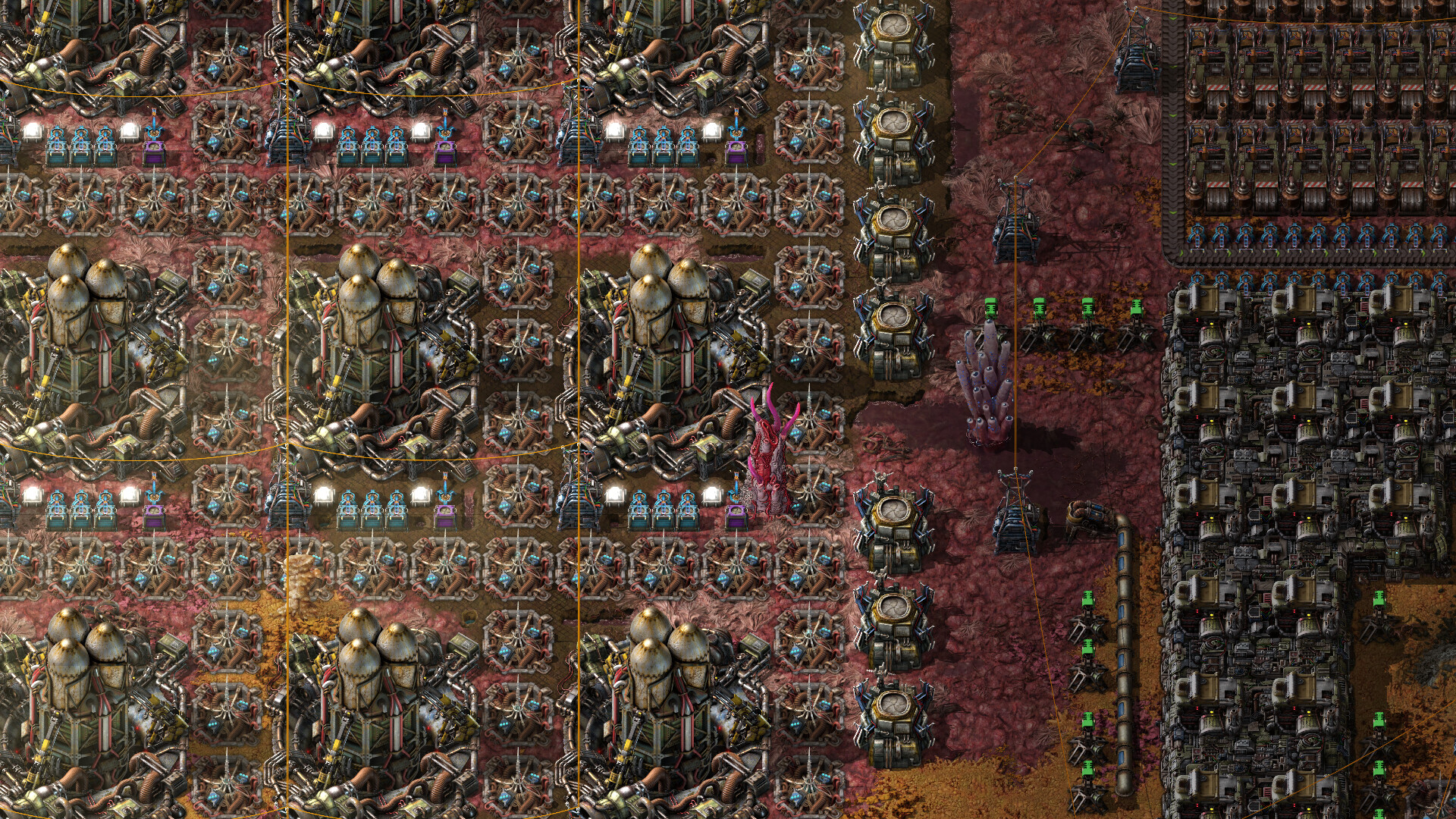
Vulcanus is a volcanic world with lava and giant worm creatures, so it makes sense to build many foundries to smelt large amounts of iron and copper. This world is all about advanced metallurgical technology. Fulgora is a lifeless place, with nightly lightning storms that could be used to generate electricity. But there are also high-tech fragments and the ruins of a long-forgotten civilisation. Everything here revolves around the advanced electromagnetic and superconducting powers of Holmium. On Gleba, a swamp world, you can cultivate exotic plants and reap the rewards, which will also attract the attention of the inhabitants. However, as the products spoil quickly, you'll need to process them quickly. Biochemical engineering is the name of the game here. The fourth and final world is the Ice World of Aquilo, where almost nothing works without heat pipes. It's here that you'll unlock the power of cryogenic technology and fusion power. Space Age builds on the familiar concepts of the main game, but expands on them in a creative way, with each planet requiring a different approach. This adds more variety to the game, including the visuals.
Even concepts from the main game are greatly expanded, such as the quality system. Every item, creature and piece of equipment has five possible qualities, from normal to legendary. Each level of quality gives a greater bonus, machines craft faster, equipment is more powerful, turrets have a greater range, and so on. This turns the entire production and optimisation pipeline upside down again. And railways, as the means of transport between the bases, can now be built on elevated platforms (elevated rails) to cross obstacles.
The free update for Factorio to version 2.0 will also be released together with Space Age. It includes quality-of-life improvements, performance optimisations, new UI elements and tweaks. These include better use of blueprints, improved control of the train system, changes to the track network and a complete rewrite of the fluid system. The latter has been simplified, but in two blog posts the developers explain exactly why this was necessary.
Factorio has always been the kind of game you can easily spend hundreds of hours playing. Factorio: Space Age takes this gameplay to new heights, ensuring that it remains the undisputed king of the automation genre.