Blades of Fire

– 4 min read

Announced at the end of February 2025 and released less than three months later, that's what happened with Blades of Fire from 505 Games and MercurySteam. But behind the generic-sounding name lies a fantasy action adventure that has turned out really well, particularly when it comes to intense combat.
No, it's not a Souls-like game, even though enemies respawn. Blades of Fire is instead a classic, combat-focused dark fantasy action-adventure game, reminiscent of titles such as Severance: Blade of Darkness and Castlevania: Lords of Shadow - also developed by MercurySteam - and, once again, the intense battles are the main highlight.
Players take on the role of Aran de Lira, the firstborn of the King's Ward. He must fight the forces of the evil Queen Nerea, who has the power to turn steel to stone. This renders all resistance to her tyranny utterly futile. However, Aran is blessed with a sacred hammer that enables him to forge his own steel weapons. He must find his way to the Royal Palace and assassinate the Queen. He is assisted by Adso de Zelk, a young scholar who documents his journey, offering insights along the way and speaks the lost tongue of the divine forgers. The story only really picks up speed towards the end, and it is said that it takes between 60 and 80 hours to complete the game.
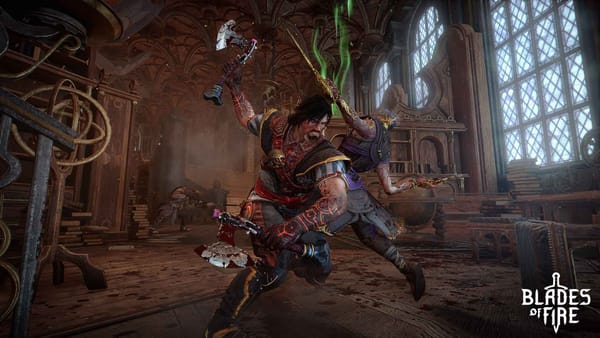
Thanks to its powerful, cinematic fight choreography, dynamic camera angles and the ability to perform directional attacks, Blades of Fire really shines in combat. Players can swing their weapons from left to right or target specific body parts, such as the head or torso. When focusing on an enemy, the game clearly shows which body parts can be attacked with the currently equipped weapon and the types of damage that can be inflicted, such as slashing, stabbing and blunt force. Therefore, it is important to use the most effective weapons in combat from the best possible angle. Only the right weapon will enable players to overcome the enemy's armour; certain types of armour are completely impervious to some weapons. Attacks cost stamina, which can be quickly replenished by blocking. Parrying enables players to break the enemy's defence, and there are more than 50 enemy types.
Each weapon slowly dulls and degrades depending on how often and how sensibly it is used (including when used to destroy objects in the environment), which is why it is important to use the right weapons against the right enemies in order to preserve their durability. However, weapons can be repaired at anvils (checkpoints) or broken down into crafting materials.
Weapon forging is an important part of the game and acts as the progression system. Players can find over 30 unique forging scrolls, most of which require them to kill a certain number of enemies, and use them to craft weapons that suit their fighting style from seven different weapon families. The chosen weapon family and the materials used to craft it influence characteristics such as weight, length, durability, penetration, and cutting quality - thus affecting how the weapon feels and performs in combat. Players must also control how Aran hammers the weapon into shape in a mini-game. Sadly, the mini-game isn't that great and doesn't fit well with the action-packed gameplay, but fortunately it can be skipped later on.
Blades of Fire is set in an interconnected world with various alternate paths and some cleverly placed shortcuts, with some really well-designed levels. There is also a helpful function to guide players if they get lost. Searching the environment for hidden locations is also worthwhile, as players can often find useful upgrades for health, stamina and potions there. Although there is no classic RPG-like stat or level system, there are three difficulty settings that can be changed at any time. The game is challenging, but not overly difficult as soulslikes. If Aran is defeated in battle, he will drop his weapon at the location of his death and respawn at the nearest anvil checkpoint. All enemies in the area will also respawn, providing resources for forging weapons.
"Blades of Fire is the culmination of years of passion, innovation, and storytelling from the incredible team at MercurySteam. We can't wait for players to dive in and forge their legend." Neil Ralley, President of 505 Games
Blades of Fire was developed by Mercury Steam Entertainment S.L., operating as MercurySteam, a Spanish video game developer based in San Sebastián de los Reyes, north of Madrid. The company was founded by former members of Rebel Act Studios, who developed (Severance) Blade of Darkness in 2001. In 2010, MercurySteam made a name for themselves with Castlevania: Lords of Shadow and Castlevania: Lords of Shadow 2, in collaboration with Konami. Although Spacelords failed to take off, the developers demonstrated their capabilities once again with Metroid: Samus Returns and Metroid Dread (2021), both of which were developed in collaboration with Nintendo EPD. Incidentally, MercurySteam is using its own Mercury Engine for the game. The publisher is 505 Games, a subsidiary of Digital Bros with offices in the United States, the United Kingdom, China and Japan. Its catalogue includes Death Stranding (PC), Control (even though Remedy bought back the IP), Assetto Corsa EVO, Ghostrunner, Gems of War and Bloodstained: Ritual of the Night, and Brothers: A Tale of Two Sons.
Blades of Fire is available on PC (exclusively through the Epic Games Store), PlayStation 5 and Xbox Series X|S, priced at €59.99. A digital artbook and soundtrack featuring 20 tracks composed by Óscar Araujo (Castlevania: Lords of Shadow) is also available to purchase through the Epic Games Store. The two console versions are available in retail outlets in collaboration with distributor Flashpoint.
It feels a bit like it's fallen out of time, but it's a really good action adventure game. The demo only hints at how good the combat-focused Blades of Fire will become.