Genre Spotlight: Tower Defense

– 7 min read

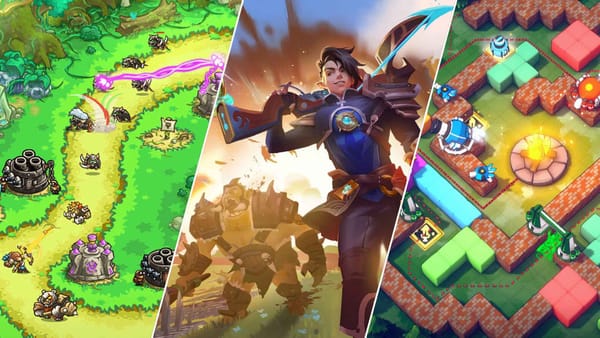
Although the golden age of Tower Defense games has long since passed, there are still some standout titles that rely on the concept, sometimes to great success. This spotlight article examines five games or franchises in the genre: Kingdom Rush 5: Alliance TD, Orcs Must Die! Deathtrap, Emberward, No Creeps Were Harmed TD and Age of Defense.
Tower Defense (not defence) is a subgenre of real-time strategy in which enemies, usually moving along fixed routes, are attacked and decimated by automatically firing towers. So that they do not reach a certain point on the map. If the routes of the opponents can also be influenced, a maze aspect is added.
Tower Defense (TD) games reached their peak in the early 2000s thanks to the Warcraft 3 map editor, especially for multiplayer games. The late 2000s saw a wave of games using Adobe Flash and the emergence of the mobile app store. More and more 3D spin-offs followed. The genre has not died out since then, but it has lost some of its prominence in recent years, although there are many TD experiences on platforms such as Roblox. Some of the most notable examples include Fieldrunners, GemCraft, Plants vs. Zombies, Defense Grid, Creeper World, Element TD and, of course, the colourful, monkey-filled Bloons, which has already attracted millions of players. Or the recently launched Kunitsu-Gami: Path of the Goddess. Fun fact: TD or Defense is often included in the title of a game to make it clear what kind of game it is.
In this article, we take a look at five past or upcoming games in the genre that have either defined it or brought new ideas to the table.
The Kingdom Rush series, available on mobile and PC, is one of the most successful franchises in the genre. The latest instalment is Kingdom Rush 5: Alliance TD, which was released at the end of July 2024. And with over 21,000 CCUs at launch on Steam, the game got off to a pretty impressive start for the very specialised genre (okay, Bloons TD 6 is a bit bigger), especially since its 2020 predecessor, Kingdom Rush Vengeance - Tower Defense, had a CCU peak of 3,200. In the end, though, players of the Kingdom Rush series will get exactly what they expect and what the previous titles offered, especially since the hand-drawn style and animations are unmistakable, even if some elements have been developed.
In Kingdom Rush 5: Alliance TD, for example, players can have two playable heroes on the map at the same time, combining their unique abilities. The tower system has also been revamped with 15 towers, each with special abilities. The game offers complete flexibility in the placement of towers, making tactical planning and decision-making crucial to victory, and this applies to all 15 campaign maps, which contain not only Easter eggs in the form of pop culture references, but also special effects that can take out the towers, making their combination and placement particularly important. Despite having two heroes, there is no co-op mode. An elite campaign will be added in October, featuring three stages, two heroes and a new tower to conquer.
The pricing is also smart. On PC, you buy the game for a fixed price of just under 20 Euros and get access to all the content. On mobile, the title costs less, but not all content is accessible - or players can use a Play Pass subscription.
The game has been developed by Ironhide Game Studio in Uruguay. The studio was founded in 2010 and has grown mainly thanks to the Kingdom Rush series, with Iron Marines and Junkworld lagging somewhat behind. The huge success of Kingdom Rush is no coincidence: the first game alone has been downloaded over 100 million times in three years on the iOS App Store, and the developers have kept both the unique style and the basic concept, tweaking and improving it all the time. With Kingdom Rush, buyers know exactly what they are getting.
The franchise Orcs Must Die" from Robot Entertainment is also one of the best-known representatives of the genre, albeit from a third-person perspective and with much more action. Tower Defense is still at the heart of the game, although you build stationary traps rather than classic towers.
Orcs Must Die! Deathtrap, the sequel to Orcs Must Die! 3, is the fifth instalment in the series, which now has over twelve million players, aims to build on the strengths of its predecessor. Features include four-player co-op, new heroes with a skill tree for progression, separate progression paths for weapons and traps, and an expanded level variety. Rogue-lite elements in the missions should also increase replayability. It is scheduled for release in the first quarter of 2025 on PC and Xbox Series X|S.
Having played the game for the first time at gamescom 2024, it feels very similar to its predecessor, even though the heroes have more skills and unique abilities (even in melee) and the barricades for creating mazes are limited but no longer cost anything. The mix of action-packed, over-the-top comic-book-style combat against cute and cuddly fantasy enemies and the building of traps and towers is great fun, especially in co-op.
The first Orcs Must Die was released in 2011 and combined strategic Tower Defense with third-person action. Part two followed just a year later. The biggest new feature was a co-op multiplayer mode. In 2017, Robot Entertainment tried free-to-play and PvP with Orcs Must Die! Unchained, which was not well received by players. "We learned a lot about the challenges of sustaining a free-to-play game. While it didn't last as long as we hoped, fans still tell us that they loved the unique heroes we created," wrote the Studio from Texas. After Orcs Must Die! Unchained, they needed to get back to the basics of what made the franchise successful in the first place: Orcs Must Die! 3 - initially exclusive to Stadia for a year, then to PC and consoles. Nevertheless, the third game achieved over 13,000 CCUs and received a total of two expansions, and in the end the game may have saved Robot Entertainment: "We explored some new additions to gameplay such as War Scenarios, where we significantly increased the number of invading orcs, and Scramble Mode, where we first experimented with roguelite concepts. This version has been a nice success and inspired us to push on."
From solo developer RefiCHL of Taiwan comes Emberward, which launched in Early Access in June 2024 - and has received an "overwhelmingly positive" response on Steam. 96 percent of the nearly 1,200 user reviews are positive. The game is a rogue-lite tower defense where you build mazes with (randomly selected) tetromino blocks and defend them with unique towers. Yes, that's right, before the game starts, Tetromino blocks are randomly placed on the map, changing the route of your opponents and allowing new towers to be built. It's not just a matter of using the limited number of wall blocks to slow down the enemy's progress. And after the battles, runes can be used to improve the towers, grant special abilities to blocks or change their size.
All of this is tied into the progression of each character, making each run unique and allowing players to collect new towers, block cards or power relics.The roguelite makes the first run relatively tricky, but not impossible on normal.
The game derives its appeal not only from the fact that it combines Mazing and TD, but also from the fact that the numerous possibilities and upgrades of the towers, combined with the placement of the random elements, promise a surprising complexity in terms of gameplay depth - and the roguelite and random elements also make for high replay value.
Even in Early Access, the game is an unexpected highlight of the genre, and will continue to mature with content updates over the coming months.
While Kingdom Rush, even with its different difficulty levels, is aimed at as many different types of player as possible, No Creeps Were Harmed TD from MinMax Games is more of a game for advanced defense specialists who like to rely on fairly complex maps in 3D space - as well as mazes, i.e. diverting enemy waves through towers or other structures to influence or ideally extend the enemy's path so that they pass more towers. Again, the game tricks you with special enemies that can teleport, for example, which in turn means new ideas for this type of enemy. Later there are cloaked enemies, enemies with armour or creatures that attack the defences. And then there's the verticality that a disembodied brain takes care of.
“Fight creeps from above, below, on the walls, or even on the ceiling. Every bullet, bomb, beam, and blaster is fully simulated in the third dimension! Turrets need line-of-sight to fire, so down in front! Mortars carelessly lob shells across huge distances. Shotgun turrets splatter bullets everywhere, sometimes hitting the intended target,” MinMax Games says.
No Creeps Were Harmed TD left Early Access in the wake of Kingdom Rush 5: Alliance TD, and went down with a CCU of under 500, due not only to the niche nature of the title, but also to the uninviting visuals, despite being a genuinely multi-layered game that demands more from the player and doesn't have the cute, clean look of Kingdom Rush or Bloons.
After Warstone TD in 2018, Battlecruiser Games released another game in the genre this year with Age of Defense. It is largely based on genre standards and a relatively fresh Stone Age scenario - stylistically much closer to Kingdom Rush, as opposed to Warstone TD, which relied more on its own style. It is a thoroughly solid title that has little to offer beyond the Stone Age.
Like Emberward, Age of Defense allows you to try out the game in advance. Emberward, for example, had a demo, while Age of Defense lets you play a free prologue called Age of Defense: Prehistory, which includes some missions to try out. However, both the prologue and the full version have not been as well received as other titles, with players complaining about bugs and the interface on Steam in particular.
And that's just a selection of some of the actual games in the genre. There are others, of course, such as Axon TD: Uprising - Tower Defense or Tower Factory. In Axon TD, from Element Studios, the developers of Element TD 2, the maze aspect is particularly important, as you can expand the layout of the map yourself - even cooperatively with up to four players. Tower Factory by Gius Caminiti, on the other hand, expands on the familiar concept with automation and rogue-lite elements. Players must optimise resource production using conveyor systems, while defending against waves of monsters. Factorio shows that this mix can work, because in this automation highlight you also have to defend your bases against attackers. Meanwhile, Asobism's ShapeHero Factory is set to combine factory simulation, roguelite and tower defense. "Use different shape combinations to mass-produce a variety of heroes, who will then fight all on their own." It will be released in November 2024.