The Demographic Bleed: Where Gaming’s Most Valuable Players Are Actually Going
In 'Zoran's Update', experienced games manager Zoran Roso comments on current industry topics on LinkedIn. This time's topic: Matthew Balls latest "The State of Video Gaming 2026" report and the topic of the "demographic bleed" happening right now in the gaming industry.
If your latest title is struggling to hit its engagement KPIs or your live-service retention is softening, you might be looking at the wrong competitor matrix. As publishing and marketing professionals, we spend a massive amount of time analyzing our direct genre rivals. But the hard truth in 2026 is this: we are no longer just fighting other publishers for player retention, we are fighting an entirely new, highly optimized category of interactive dopamine loops.
And right now, the traditional video game industry is losing ground in its most critical demographics.
Let’s look at the data, because the shift in where the money is actually flowing is staggering.
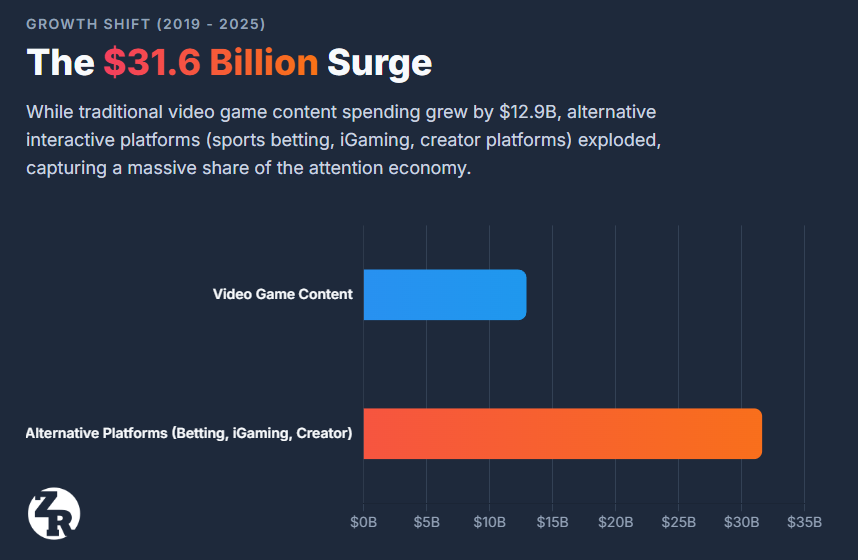
Between 2019 and 2025, American consumer spending on video game content grew by a respectable $12.9 billion. A solid number on the surface. However, during that exact same window, spending on alternative interactive platforms, specifically sports betting, iGaming, prediction markets, and creator monetization platforms like OnlyFans, exploded by $31.6 billion.
Source: Epyllion, Matthew L. Ball
We aren't just competing for "gaming time" anymore; we are competing for "interactive leisure spend," and alternative platforms offer a frictionless, high-stakes dopamine hit that traditional gaming is struggling to match.
The most alarming part of this trend? The demographic bleed.
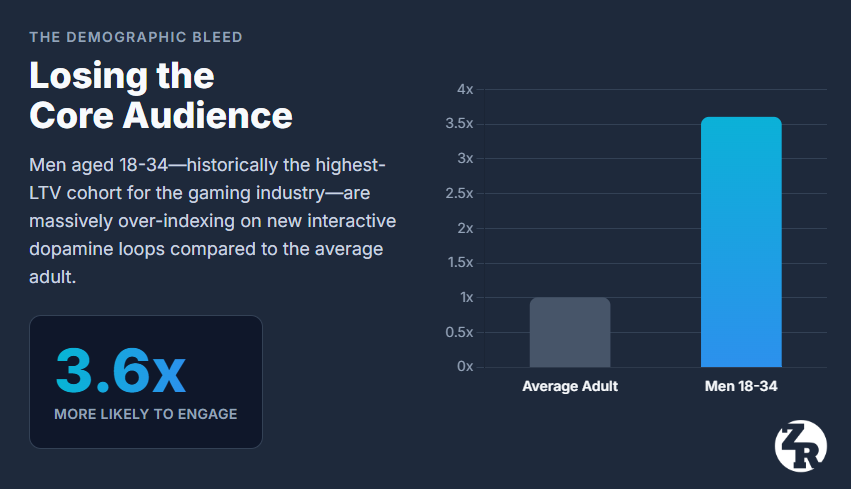
The core audience that has historically driven the gaming industry's most lucrative, highest-LTV franchises, men aged 18 to 34, is actively migrating. According to recent data on the state of the industry, this specific cohort is currently up to 3.6 times more likely to engage heavily with short-form video, prediction markets, and crypto trading than the average adult.
What does this mean for our publishing and marketing strategies heading into the rest of 2026?
1. Radically Re-evaluate Your Competitor Matrix A new live-service shooter isn't just competing with Call of Duty or Apex Legends; it's competing with the frictionless entertainment of high-velocity TikTok doomscrolling, the parasocial engagement of Twitch/Kick, and the real-money thrill of weekend sports parlays. If your marketing funnel only targets "fans of shooters," your Total Addressable Market (TAM) is actively shrinking.
Source: Epyllion, Matthew L. Ball
2. Friction is the Enemy of Acquisition Alternative interactive media gets the user to the "dopamine hit" in seconds. Traditional gaming still forces players through massive downloads, lengthy tutorials, and slow matchmaking. From a product and marketing perspective, we have to ruthlessly optimize the "Time-to-Fun" metric. Cloud streaming, instant-play demos, and frictionless onboarding are no longer nice-to-haves; they are survival tools.
3. Community is the Ultimate Moat Pure gameplay loops are struggling to hold attention in a vacuum. The titles succeeding in this hyper-competitive environment are those that integrate social connectivity, creator ecosystems, and high-stakes community narratives directly into the game and the marketing beat. You aren't just selling a game loop, you have to sell a social destination.
4. Adjusting LTV and UA Models As attention fractures across these new platforms, the cost to acquire and retain a high-value user (CAC) will continue to rise. Publishing strategies must pivot toward deepening monetization, personalization, and engagement with retained core audiences, rather than relying solely on a broad, leaky top-of-funnel acquisition strategy.
The attention economy is completely rewriting the rules of player engagement. Are your upcoming campaigns adjusting to this new reality, or are you still just competing with other games?
Zoran Roso stands as a highly influential veteran of the video game and entertainment industry, with a distinguished career spanning over 25 years in global publishing, marketing, and leadership roles. His professional journey includes serving in significant executive positions at some of the world's most recognizable gaming giants, including Rockstar Games/Take 2 Interactive, Activision Blizzard, and Sony PlayStation, where he was instrumental in the marketing and strategic positioning of flagship AAA franchises and brands. Most recently, he leveraged this extensive experience as the Global Publishing & Marketing Director at Tencent Games, a critical role focused on expanding the company's international reach and developing successful go-to-market strategies for its massive portfolio of internal and partner studios.
Now operating as the founder of ZR Consulting, Zoran continues to drive success in the industry by advising major global publishers and developers. His firm specializes in crafting winning strategies for international brand development, optimizing live service performance, and executing flawless launch plans across all major platforms, including console, PC, and mobile. An active figure in the global games community, his career is marked by a clear strategic vision and a successful track record in translating complex products into global commercial successes.
Zoran Roso, founder of ZR Consulting, brings 25+ years of global gaming marketing experience. Formerly Global Publishing/Marketing Director at Tencent Games, he has held leadership roles at Sony PlayStation, Activision Blizzard, and Rockstar Games.