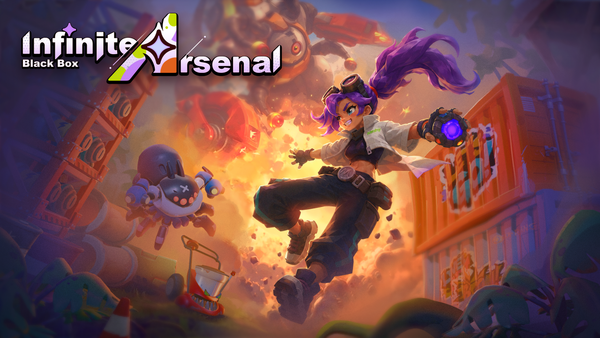
In most productions today, generative AI sits in the pipeline: assets, blockouts, iteration speed. Black Box: Infinite Arsenal tests the layer above it — the mechanics themselves. Players feed the skills they have collected into the game's black box, and an in-house model for game mechanics designs a new one at runtime, within a defined mechanic language and rule set. Feed in a fireball and a boomerang: the result is not a draw from a pre-built pool, but a mechanic that did not exist before. Remove the AI, and the game does not run.
The architecture is deliberately conservative where games demand rigidity: a conventional engine handles execution and determinism, while the AI is confined to the mechanics layer — a middle path between AI-assisted production and fully model-generated worlds. First shown publicly at GDC in March as a 2D pixel tech demo, the project now runs in 3D, with a larger skill set and a wider combination space.
For Meshy, the game extends the same trajectory as its 3D generation tools: moving generative AI from asset production toward real-time, interactive content. The 3D version is playable at Meshy's demo station in Hall 10.1, Stand, with the development team on site. For business meetings, Meshy is in the business area, Hall 3.2, Stand A040, from Trade Day, 26 August.