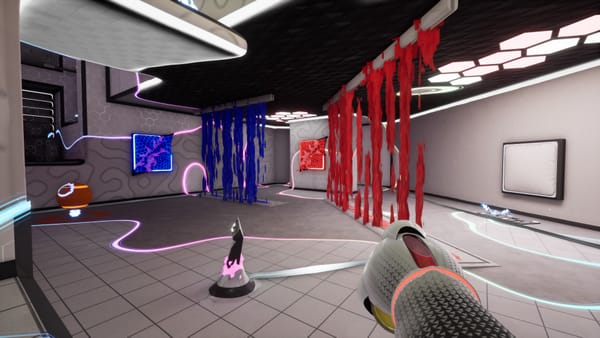
Pixel Maniacs' latest game is up there with the top games in the first person puzzler genre. While some problems exist in terms of visual clarity, the accessibility options and the tremendous player progression feel more than make up for it.
Sometimes, one game defines the frame of a genre just by being the best example of it. In the case of first person puzzle shooters, this is no doubt Portal 2 (or, well, the first Portal game for purists, I guess). The yard rod for any game which leads players through puzzle rooms with a gun that shoots anything but bullets, most games in the genre are measured against Portal 2, and strife to become “the next Portal”. The entrenched comparisons are only made more mandatory when a lot of these games drift towards a very Portal-like aesthetic, either out of reverence, technical necessity or to invoke the comparison outright. Superliminal, Antichamber, even Viewfinder to some extent all share the clean testing chamber aesthetics of Portal, and ChromaGun, the 2016 game by Nuremberg studio Pixel Maniacs, does much the same. No wonder then that ChromaGun 2: Dye Hard, the much more polished and bigger title from the studio, now published and physically distributed by PM Games, hits very similar notes.
Starting directly at the end of ChromaGun but not expecting new players to actually have played that one, ChromaGun 2 uses humour very akin to Portal 2’s GlaDOS to ease us into its world filled with testing chambers. The main verb of the game is colouring: A tri-colour ChromaGun (which breaks for the tutorial, leaving us to learn the game with just yellow) is used to induce what the game calls ‘Chromatic Magnetism’: Same-coloured objects pull towards each other. Simple in concept, this game mechanic is then stacked with wildly creative puzzle setups and a story that puts many familiar concepts together, from different dimensions to smooth-talking test operators overseeing a range of sterile testing chambers.
Before I get into the meat of the review, I have to put the disclaimer here that I am not entirely impartial, because I know and like many parts of the development team as people and because I have worked in a very small capacity for them as a PR freelancer writing a handful of texts before becoming part of the current GamesMarkt team. This hasn’t influenced my opinion of the game and I have plenty of criticism to share below, but make of this information what you will.
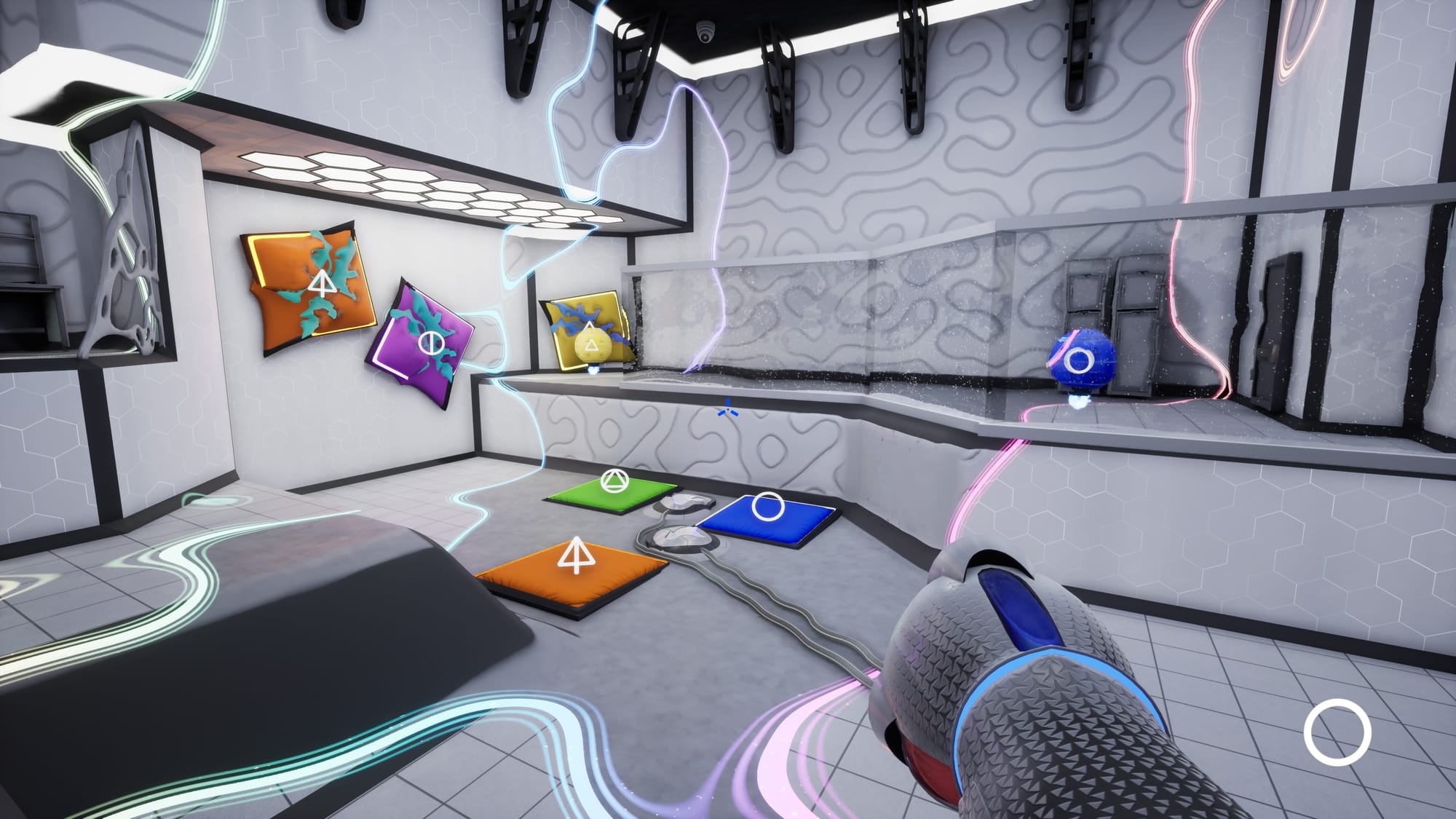
Colours, orbs, switches and jumping puzzles: ChromaGun 2 has enough mechanics to become complex, but not confusing.
While the puzzling, jumping and colouring is at the heart of ChromaGun 2, there is also a narrative, albeit a relatively simple one: You break your ChromaGun, so instead of manufacturing a new one, the villain of the first game sends you into an alternative dimension to steal one because he wants to cut costs. This goes as wrong as can be expected, and several new comedic and narrative possibilities spring from the interaction of said antagonist, Richard, as well as his different-dimension alter ego Mildred. The narrative works, although it suffers from a few continuitity breaks in the last chapter of the game, like when an important character is broken for one a while (which is in itself an interesting game mechanic again) and then suddenly whole again in the next section, without explanation. That doesn't stand out too negatively though, since the driver for most of the story and what little character progression there is is humour, very akin to Portal 2’s GlaDOS. And while humour is always subjective and many of the jokes will surely be hit or miss with a lot of players, I came to snicker a lot during the game, especially because of some of the subtler jokes. I know, I am a simple mind, but being sent into a “more advanced” universe which is basically the same one but British instead of American is the kind of pure and simple stupid that I can appreciate. Some of the visual gags land lovely as well, such a Companion Cube style asset in later levels being just another interactable object, but with a little propeller hat on top.
Please Sir, May I Have One More Colour
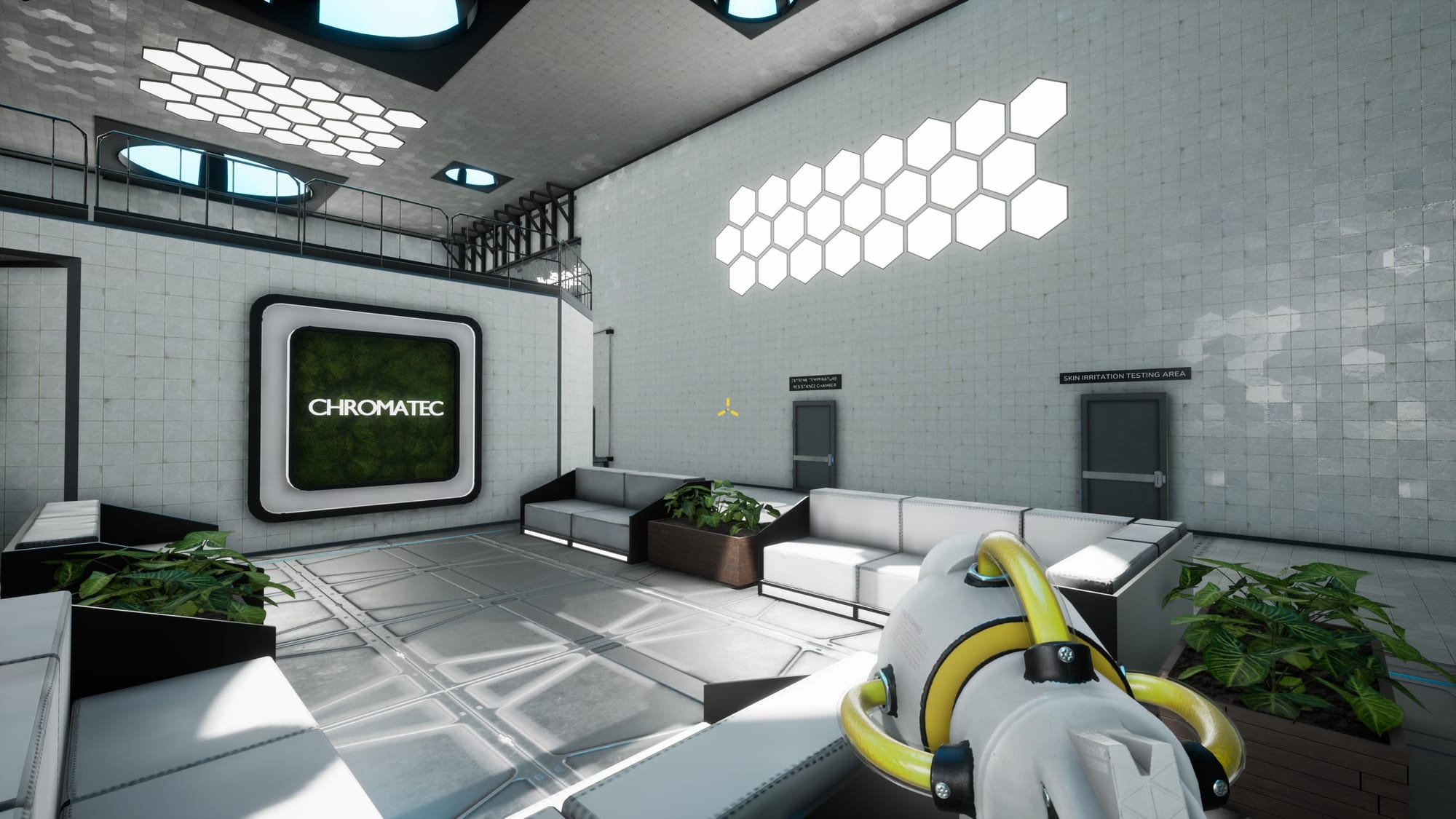
Alas, talking about visual design, I do have some criticism. In my opinion, the game suffers from a lack of readability in one key part: namely the recognition of interactable objects. Everything in the game world is more or less white: From the testing chamber walls to the office furniture to the basic version of all interactable puzzle components: colourable wall panels, boxes and the main puzzle object, the WorkerDroids. This is a problem inherent to the game mechanic: While the Portal-like sterileness of the testing chamber environment certainly doesn’t help, it’s not the main root of the problem. Colours are the game mechanic of ChromaGun, and everything that has one of the seven interactable colours of the game – blue, yellow, red, the combinations green, violet and orange, as well as the ‘overmixed’ black – is expected by players to be interactable. Therefore, everything non-interactable has to be neutral, either white or beige. The problem is, everything interactable has to be white as well, because it must be colourable.
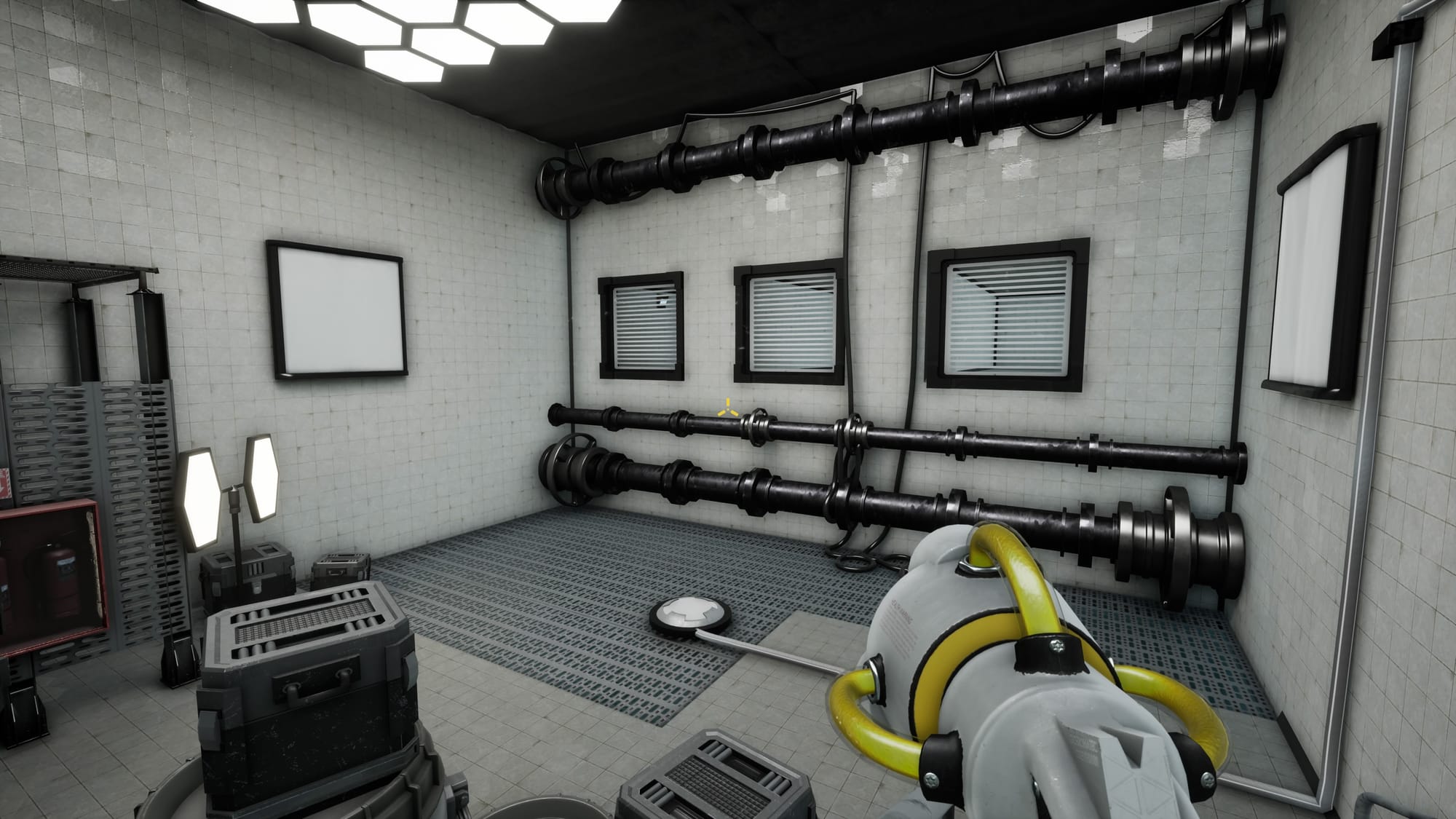
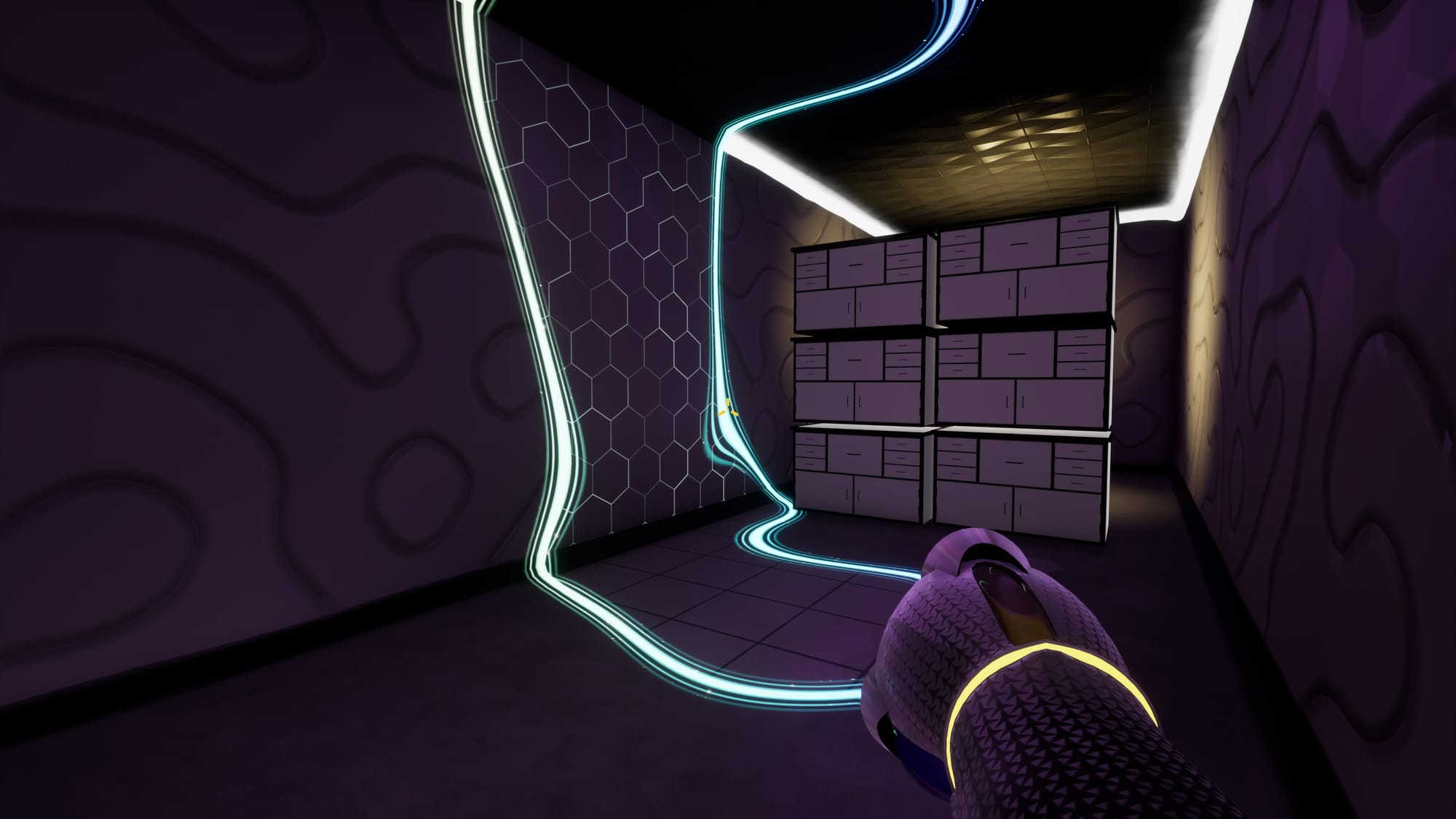
Several things in this screenshot are interactable. Nothing in this screenshot is interactable.
The developers are quite aware of this problem, as we discussed in an interview with Pixel Maniacs’ CEO Ben Lochmann, and they tried to navigate it with material textures and certain patterns: colourable wall panels are made from fuzzy cloth, while the walls are made from clean metal. At the same time however, the wall panels often use futuristic grooves and patterns, while the panels are clean white. Both ways of showing the difference work, but in combination they sometimes merely add to the confusion. The problem is especially prevalent in the first two chapters making up about a full third of the game. In several rooms in both chapters, puzzles took me up to twenty minutes longer because I stared right through a wall panel without realising it was there, or because it wasn’t made entirely clear that some white office cabinets are colourable while most furniture is non-interactable. The problem goes away when players develop a more refined view for the game world and it is mitigated even more in later chapters, when the cross-dimensional twists of the story introduce more visual features to the game world, but I gather that until then, many players might have gotten frustrated and stopped playing.
Very rarely, other things apart from Droids have to be moved by colouring them. It is not often as clear as here which these are.
A Masterworks in Player Progression
Despite these issues, I am very impressed with the feeling of progression the game invokes, especially since its base puzzle mechanics never change: It’s always you, a three colour gun and colourable objects in the game world. Within this limited set of mechanics, the team has taken the clever decision of allotting a kind of core mechanic to each game chapter, without taking this restriction too far. Those mechanics stack with ongoing playtime, which naturally means that later chapters include much more challenging puzzles than the ones before. Since new puzzle designs are never introduced out of the blue however, this ramp happens slowly, and makes me feel very clever as a player when I am able to “introduce” a mechanic for the first time by using the pieces that are given to me – a designer intention of course, but it feels amazing to, say, stack WorkerDroids for the first time in the third chapter of the game. To keep with this as an example: This mechanic is used the first time long before it is put into the center of attention, in a side puzzle or as part of a bigger puzzle room. When it then comes into full focus in Chapter 4, stacking isn’t merely repeated over and over again, but it is paired with another core mechanic that dominates the chapter (and which I will not spoil here). This constantly evolving moveset is not prescribed by ingame skills or upgrades, but just by the design of the puzzle rooms and a player’s imagination on how to use it. The curve of progression in ChromaGun 2 is so good, I would put it into the Olymp of first person puzzle shooters just for that. For me, ChromaGun 2: Dye Hard is right up there with Viewfinder and Superliminal, and only short a few interface polishments before it can grasp for the Portal 2 throne. Knowing what a small team made this game and seeing how polished and thought-through it actually is, this is truly one to try out if you like the genre.
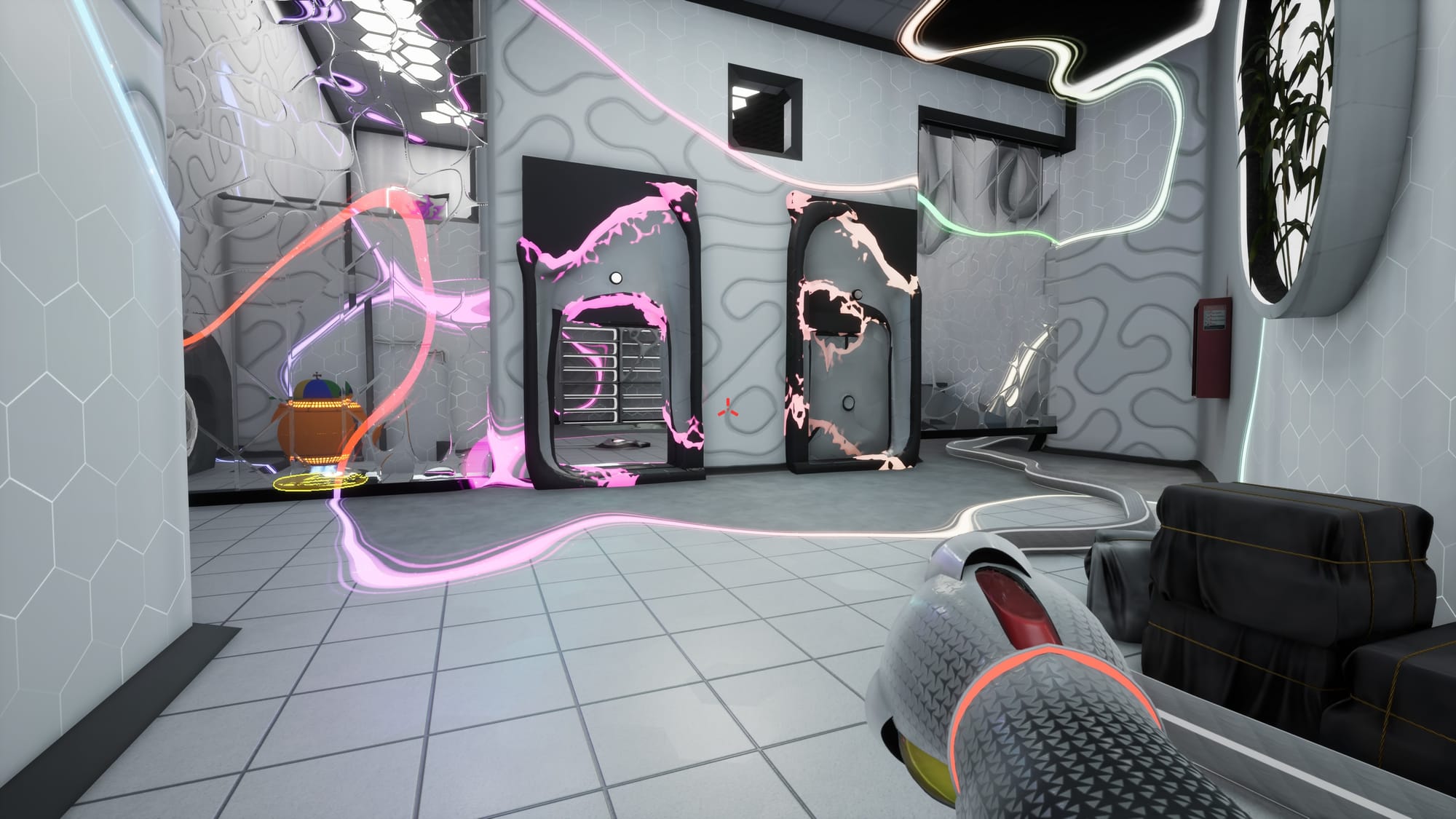
The colour-blind mode of the game is spectacularly clever.
And with the amazing colour-blind mode the team has invented in ChromaGun and refined in ChromaGun 2, it is also a great example of accessibility features. You can read more about that in the interview we did with the developers as well.
Conclusion
Up there with top genre titles such as Viewfinder, ChromaGun 2: Dye Hard is only a few player experience steps away from being a masterpiece.