The Game Studies Watchlist newsletter, curated by Prof Dr Rudolf Inderst, is published weekly on GamesMarkt. This week's topics include an Elden Ring anthology, a new Zelda call, HeroQuest and jobs.
HeroQuest will always hold a special place in my heart... so, let’s not dwell on that any further (nor on the PC game that always brought my underperforming computer in the playroom to its knees). BUT: On my first visit to a small Munich shop full of board and role-playing games, as a young customer I could hardly believe my eyes when I spotted something called Advanced HeroQuest. Naturally, I splashed out a week’s pocket money and... swapped it a month later with my oldest friend Michael for his copy of StarQuest (originally: Space Crusade). I know, I know, yet another... foolish act of my youth. Right, enough CV drama! Let’s talk about today, let’s talk about the video post by Jordan Sorcery.
Advanced HeroQuest was Games Workshop’s 1989 follow-up to the tabletop phenomenon HeroQuest. [...] n this video history Jordan Sorcery explores the development of the game, the business reasons behind its existence, the material that was released to support it, and the legacy that it has left.
From my perspective of a game studies and design scholar, Advanced HeroQuest marks an important transitional moment between traditional tabletop systems and modern dungeon-crawling design. Building on the great accessibility of HeroQuest, it introduced procedural dungeon generation, asymmetrical player roles, and a rules framework that supported emergent narrative rather than fixed scenarios. This shift reflects an early move toward systems-driven play, where unpredictability and replayability become central design goals, anticipating mechanics later refined in both tabletop RPGs and digital roguelikes. At the same time, its complexity reveals the tension between simulation depth and usability, making it a valuable case study in how designers balance player agency, system transparency, and cognitive load.
For over a decade, Hamish Black’s channel Writing on Games has demonstrated that games invite the same attention we bring to literature or film. In our conversation for TITEL kulturmagazin, he reflects on criticism, creative practice, and the uneasy condition of contemporary game culture.
The Department of Languages, Literatures and Cultures at the University of Delaware needs an adjunct instructor to join their team, teaching "Introduction to Game Studies" and an upper-level class in Fall 2026. More info here.
But hold on, there's more: The University of Europe for Applied Sciences (UE) in Berlin is looking for a Professor of Game Design with a focus on Creative Coding / Game Programming, check out what they have to offer right here:
On LinkedIn, I read a posting from Athanasios Mazarakis, where he stated: "In our new paper, "AI-driven game design: the EMPAMOS gamification framework", we analyzed around 8,300 board game manuals to systematically understand which design elements and their structured combinations ("design patterns") make games and gamification engaging and motivating." And ... it's Open Access! Here you go.
For the German speaking audience here, I got two news today:
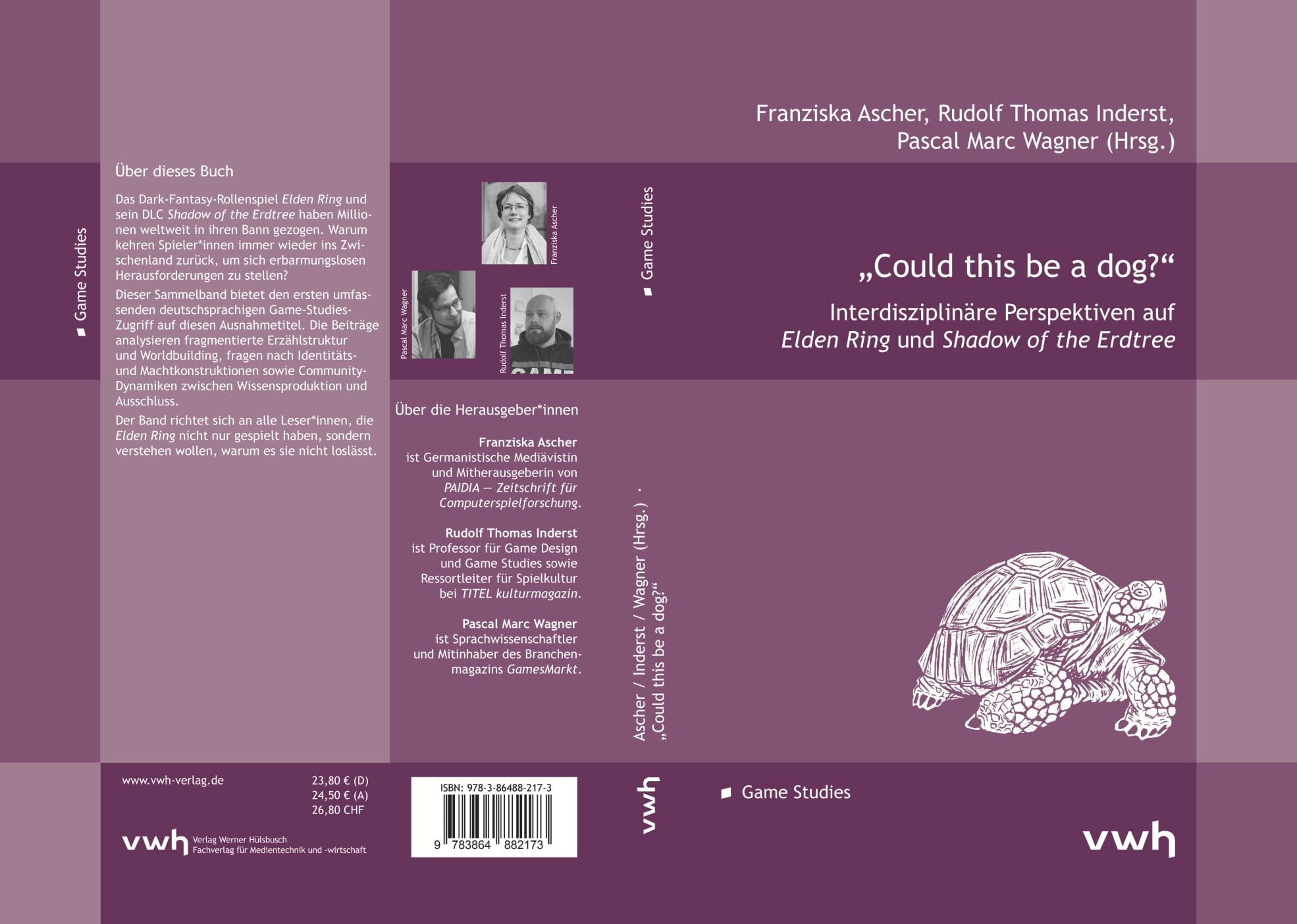
I’m delighted to celebrate the release of „Could this be a dog? Interdisziplinäre Perspektiven auf ‚Elden Ring‘ und ‚Shadow of the Erdtree‘“ (published by Verlag Werner Hülsbusch), a project I had the pleasure of co-editing together with Franziska Ascher and Pascal Marc Wagner. Bringing together diverse voices from across disciplines, the volume explores the rich aesthetic, narrative, and ludic dimensions of Elden Ring and its expansion Shadow of the Erdtree, opening new perspectives on how these worlds resonate within game studies and beyond. It has been an inspiring collaborative journey, and we hope the book invites readers to engage with these games in new, thoughtful, and sometimes unexpected ways. Get your copy right here.
Cover of the academic anthology about Elden Ring, out now. GamesMarket co-owner Pascal Wagner is one of the editors. (vwh)
We are pleased to invite submissions for our upcoming volume via Mythos Hyrule, a games studies anthology dedicated to exploring the rich mythological, cultural, and aesthetic dimensions of the The Legend of Zelda series. As co-editors (yes, there's four of us!), we seek contributions that engage with Hyrule as a site of interdisciplinary inquiry, ranging from narrative theory and game studies to mythology, media history, and cultural analysis. In line with broader developments in mythological game studies, which examine how games both represent and generate mythic structures , we welcome abstracts that open new perspectives on the enduring resonance and scholarly potential of this iconic series.
... by the way, my heart’s been racing since yesterday because my publisher has let me know that my thesis is now being printed, which means that I’ll hopefully soon be able to hand in my statutory copies to the university library, bringing me another small step closer to my final PhD certificate – exciting times indeed! And if you really need to know, yeah, it's still Arc Raiders all the way. Have you seen that sunset? HAVE YOU?
P l e a s e support my work in game research & culture, consider contributing via Buy Me a Coffee.
Rudolf Inderst is a Professor of Game Studies, Podcast Host of “Game Studies”, Newsletter Writer of “Game Studies Watchlist” , Video Essay Aficionado and Krav Maga Practioner.