At its annual developer conference, GTC (GPU Technology Conference), Nvidia unveiled DLSS 5. "Twenty-five years after Nvidia invented the programmable shader, we are reinventing computer graphics once again," said Jensen Huang, founder and CEO of Nvidia. "DLSS 5 is the GPT moment for graphics - blending hand-crafted rendering with generative AI to deliver a dramatic leap in visual realism while preserving the control artists need for creative expression."
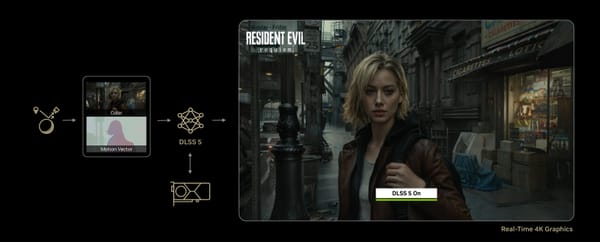
DLSS 5 uses an AI model to infuse the scene with "photorealistic" lighting and materials that are consistent from frame to frame and anchored to source 3D content. It takes a game's colour and motion vectors for each frame as input. Nvidia emphasises that it is not just a filter that is applied to the scene. DLSS 5 runs in real time at up to 4K resolution, but currently only on top-of-the-range hardware. However, it is set to be further optimised by the end of the year. At GTC, an early prototype was demonstrated using two RTX 5090 graphics cards.
Nvidia: "The AI model is trained end to end to understand complex scene semantics such as characters, hair, fabric and translucent skin, along with environmental lighting conditions like front-lit, back-lit or overcast — all by analyzing a single frame. DLSS 5 then uses its deep understanding to generate visually precise images that handle complex elements such as subsurface scattering on skin, the delicate sheen of fabric and light-material interactions on hair, all while retaining the structure and semantics of the original scene."
Following the unveiling of DLSS 5, Nvidia received more negative feedback than usual from the public. Many criticised the new visual style for resembling the typical 'AI slop' aesthetic, which may not align with the developer's artistic vision for their game. In this regard, Nvidia has clarified that DLSS 5 provides game developers with controls for intensity, colour grading and masking, so that artists can determine where and how enhancements are applied to preserve each game's aesthetic. The integration is seamless, utilising the same Nvidia Streamline framework used by existing DLSS and Reflex technologies.
This autumn, DLSS 5 will be released and supported by publishers and developers such as Bethesda, Capcom, Hotta Studio, NetEase, NCsoft, S-Game, Tencent, Ubisoft, and Warner Bros. Games. It will be available for games including Aion 2, Assassin's Creed Shadows, Black State, Cinder City, Delta Force, Hogwarts Legacy, Justice, Naraka: Bladepoint, NTE: Neverness to Everness, Phantom Blade Zero, Resident Evil: Requiem, Sea of Stars, Starfield, The Elder Scrolls IV: Oblivion Remastered, Where the Winds Meet and many more. Several examples of DLSS 5 will be showcased at GTC in games such as Resident Evil Requiem, EA Sports FC, Starfield, Hogwarts Legacy, and the Nvidia Zorah tech demo.
"Nvidia and Bethesda have a long history of pushing gaming graphics and innovation forward, and DLSS 5 represents the next major step in that journey," said Todd Howard, studio head and executive producer at Bethesda Game Studios. "With DLSS 5 the artistic style and detail shine through without being held back by the traditional limits of real-time rendering. We're excited to work with this new technology and look to bring DLSS 5 to Starfield and future Bethesda titles."
"At Capcom, we strive to create experiences that feel cinematic, compelling and deeply believable - where every shadow, texture and ray of light is crafted with intention to enhance atmosphere and emotional impact," said Jun Takeuchi, executive producer and executive corporate officer at Capcom. "DLSS 5 represents another important step in pushing visual fidelity forward, helping players become even more immersed in the world of Resident Evil."
"Immersion is about making the world feel real. DLSS 5 is a real step towards that goal," said Charlie Guillemot, co-CEO of Vantage Studios. "The way it renders lighting, materials and characters changes what we can promise to players. On Assassin's Creed Shadows, it's letting us build the kind of worlds we've always wanted to."
GamesMarkt Daily Newsletter
Sign up to receive the free daily newsletter about the Games Industry in GSA, Europe and beyond.
No spam. Unsubscribe anytime.