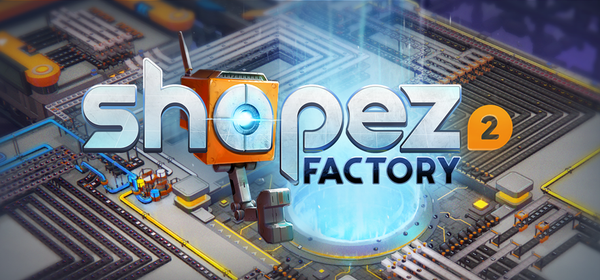
Factorio, Satisfactory and Dyson Sphere Program are the major games in the factory automation genre, all of which are million-sellers. The German developer tobspr Games has also made a name for itself in the genre with its game shapez. This 2D game involves building and optimising factories to create increasingly complex geometric shapes. Each shape has its own set of building blocks that the factories can take apart (cut), paint (color), and reassemble (combine) in unique ways. The game has sold over 1.2 million units on Steam and attracted over 10 million players to its demo on shapes.io.

shapez 2 builds on the basic concept of its predecessor, offering a bigger and more sophisticated experience in almost every respect. Like its predecessor, it is a game with infinite resources and no construction costs, enabling players to solve production and logistics puzzles at their own pace. It starts small, but as players progress, they can use the skills they have learned to build bigger and more complicated factories. This time, there is 3D gameplay, which allows players to stack up to three belts on top of each other. This 3D element is a significant improvement on the previous game. There are also no enemies, so there is no additional pressure on the player. The focus is much more on optimising production lines and perfecting automation on a truly gigantic scale.

shapez 2, which added the title "Factory" during its Early Access period to make it clear what the game is about, sees players building sprawling automated factories in space to process geometric shapes through increasingly complex production lines. By cutting, stacking, rotating and painting shapes, players must design efficient logistics systems that can be scaled up to form massive industrial networks. As production demands increase, factories expand across multi-layered platforms, challenging players to continuously optimise and refine their automation. The factory grows from a single conveyor belt to a multi-station space factory connected by space trains. However, the game is much more abstract than Satisfactory or Factorio, as it does not produce recognisable products, but abstract shapes in different fluids (colours). Fluids and pipes are also a new addition compared to the first game.

The game is relatively easy to control anyway. Parts of the factory can be cut, copied and pasted, and up to 50 operations can be undone and redone. © tobspr Games

Classic Mode

Two main game modes are available (Classic and Manufacture), as well as the Certification Scenario, which is a ~1h long tutorial that teaches all the necessary basics before transitioning into the Classic scenario. Classic Mode is the main mode from the Early Access period and offers a blend of factory building, logistics and shape puzzles. It can be played in four different modes: Normal, Hard, Insane and Hexagonal, where shapes have six sides instead of four. In this mode, players must produce and throw increasingly complex shapes into the Vortex.

The vortex that devours (lots of) shapes © tobspr Games

With version 1.0, however, Trade Stations from the Manufacture Mode, which will be introduced in the next paragraph, are added. Situated at the end of Classic Mode, the Trade Stations serve as an additional challenge, but differ from those in Manufacture Mode. "There are 5 milestones separated into 3 tiers of trade stations, starting from milestone 8 with Red, Green and Blue Trade Stations. Milestone 9 gives Cyan, Magenta and Yellow, mixed from the milestone 8 resources as you'd expect. Milestone 10 gives White and Black, which you'll need for the Vortex Grand Assembler that produces the shape you need for the final Milestone and the completion of the scenario," the developers explain. New additions include the two shapes (X and Y), which are used in Manufacture and Classic Modes (Trade Stations), as well as Vortex LTD lore elements, which have been added throughout the game. Quality of life changes have also been added, such as consolidating the speed upgrades into a global speed upgrade and making shape previews work more consistently. Pipes now have infinite throughput. However, they are still limited by the fluid launchers and catchers between platforms, which are now the main limiting factor. Trains have also been given a throughput buff, increasing their package size from 180 to 360 shapes, and from 1,800 to 3,600 litres.

Manufacture Mode

Now, let's move on to the new Manufacture Mode. This mode addresses one of the most significant pieces of feedback that tobspr Games received during Early Access, focusing on large-scale factory logistics. In the Classic mode, factories that were built for a specific shape were no longer available in later stages of the game. This has now changed — shapes are no longer thrown into the Vortex, but players supply specific shapes to a Trade Station instead. In return, the Trade Station will output a new shape type, which players need in order to supply the next tier Trade Station, and so on. Everything builds on one another. A Trade Station only continues to produce new shape types as long as it is supplied with the necessary resources. Therefore, if players want a strong output of the final new shape, they need to make sure they supply all prior Trade Stations sufficiently – and so the factories grow and grow. The goal of relaunching the Vortex Platform is to focus on large-scale, permanent factories, similar to those in other factory games.

The game has also visually improved a lot in all areas. All Milestone, Operator and Shop screens have been completely overhauled, while the expanded Codex contains almost everything for reference. There is also a Dark Mode. The update also introduces modding. Full Steam Workshop support enables players to create, share and play mods, providing the community with the tools to expand and modify the game. It is also possible to save, load, export and share factory design blueprints with anyone.

"The community's response during Early Access has been incredible. We're so excited for you to play the 1.0 release as we've delivered our most polished version of the game yet, introducing a brand new manufacture mode, new automation tools, achievements, performance improvements and countless quality-of-life upgrades." - Tobias Springer, founder of tobspr Games

About the Developer

tobspr Games is developing and publishing the game itself, with Gamera Games assisting with the publication in China and Japan. Game Drive, based in the Netherlands, is responsible for PR and marketing. The company was founded in 2018 by Tobias Springer. It all started as a hobby with a focus on web games. The first game was a tower defense game called YORG.io. Once it became apparent that a much larger player base could be established on Steam, the concept evolved into a hybrid approach: a demo version on the web and a full version on Steam. Following the success of YORG.io 3, shapez marked a significant milestone for the company, prompting its expansion.

In 2022, Springer decided to develop shapez 2, which would be much bigger, with more employees. Without the €537,833 in federal funding from the BMWK (Federal Ministry for Economic Affairs and Climate Action), it would not have been possible to grow so much, nor to increase quality and scope to such an extent. Tobias Springer told GamesMarkt in August 2023: "I'm very grateful that we got the funding, and the application and advice from DLR was also great. As a small studio in Germany, the cost of employees is really a big issue, and unfortunately there is a lot of competition abroad. Thanks to the funding we can now create five jobs in Germany." The development team employs now more than ten people.

shapez 2 left Early Access on 23 April 2026. The game is available for €28.99. There is also a Supporter Edition priced at €38.99. This includes the base game, cosmetic rail twisters and loops, an additional 50 minutes of in-game music, and the full soundtrack on Steam. The Supporter Edition Upgrade DLC is available for €9.49.

Conclusion

With the end of Early Access and the introduction of Manufacture Mode, shapez 2 Factory is taking a major step forward - especially for fans of massive factories. It's another highlight in the genre. To see what tobspr Games has in store next will be exciting!

Features
  • Factory automation with a puzzle-like feel in Classic Mode and permanent, massive factories in Manufacture Mode
  • Numerous revisions and improvements across nearly all areas
  • Total focus on factory automation with infinite resources, no construction costs, and no enemies; easy to learn, yet still offers plenty of challenges

Share this post

Written by

Marcel Kleffmann
Marcel Kleffmann is Chief of Content of GamesMarket and our B2B and B2C expert for hardware, market data, products and launch numbers with more than two decades of editorial experience. (marcelDOTkleffmannATgamesmarktDOTde)
Interview: How Is Arc Games Positioning Itself for the Future?
Arc Games: Jason Park (Chief Operating Officer), Yoon Im (Chief Executive Officer), and Michael Borras (Vice President of Business Development) © Arc Games, Borras

Interview: How Is Arc Games Positioning Itself for the Future?

By Marcel Kleffmann 7 min read
Bavaria Games Industry Study: Number of Companies Doubled Since 2018, More Hubs Needed
Bavaria’s Digital Minister Dr Fabian Mehring | Picture: StMD Anne Hufnagl

Bavaria Games Industry Study: Number of Companies Doubled Since 2018, More Hubs Needed

By Stephan Steininger 3 min read