AppsFlyer: AI Floods Mobile Gaming Marketing Channels
In its 'State of Gaming for Marketers 2026' report, AppsFlyer outlines how the scaling up of marketing activities using AI has increased global spending on user acquisition and visibility. Meanwhile, Chinese publishers are reshaping competition in mobile gaming.
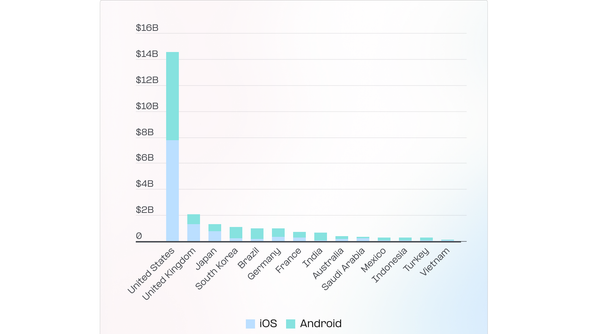
AppsFlyer, the marketing cloud, has published its 'State of Gaming for Marketers' report for 2026 (available starting Thursday, 15 January). Based on AppsFlyer data, the analysis shows how artificial intelligence, scaled advertising production and increasing competitive pressure in paid advertising channels changed mobile gaming marketing in 2025. The increased use of AI in advertising production has led to a substantial increase in advertising on iOS and Android. At the same time, publishers based in China significantly increased their influence on the international mobile gaming market. In Germany alone, for example, their share of the acquisition budget increased by 31 per cent year-on-year.
In order to cope with the growing volume and increasing complexity of advertising, many companies are relying more and more on AI-powered analytics and reporting tools. "AI has massively increased the speed and volume at which games and marketing assets are brought to market," says Adam Smart, AppsFlyer's Director of Product, Gaming. "The result is not a lack of creativity, but an oversupply. When paid activity and creative supply grow faster than player attention, marketing success becomes a matter of how effectively teams can measure, interpret and act on an ever-increasing amount of fragmented signals."
The south entrance of gamescom | Picture: Koelnmesse, Thomas Klerx
Bavaria's Minister for Digital Affairs, Fabian Mehring, delivered the keynote speech at the first GG Bavaria Business Day 2025. | Picture: Alexander Hartung for Games/Bavaria
Johannes and Simone Grünwald are Slime King Games. Their game Under the Island is an homage to classic titles like Alundra, Terranigma and Zelda (Slime King Games)