USK Annual Statistics: One in Ten Games in 2025 Was Rated 18+
In 2025, the proportion of adult games reached its second-highest level since 2004. The number of games assessed using the traditional method rose to 1,675. In addition, there were 1.3 million ratings via the automated IARC system.
As it does every spring, the Entertainment Software Self-Regulation Body (USK) has published its annual statistics, providing an insight into the workload over the past year. In total, the USK reviewed 1,675 games using the standard review procedure in 2025. That is 160 more than in the previous year, but still around 200 fewer than in 2023. A USK rating obtained through the standard procedure is a prerequisite for any game to be sold as a physical product in high street shops or via e-commerce in Germany.
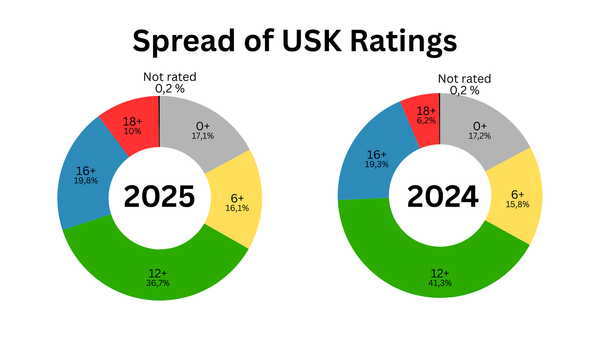
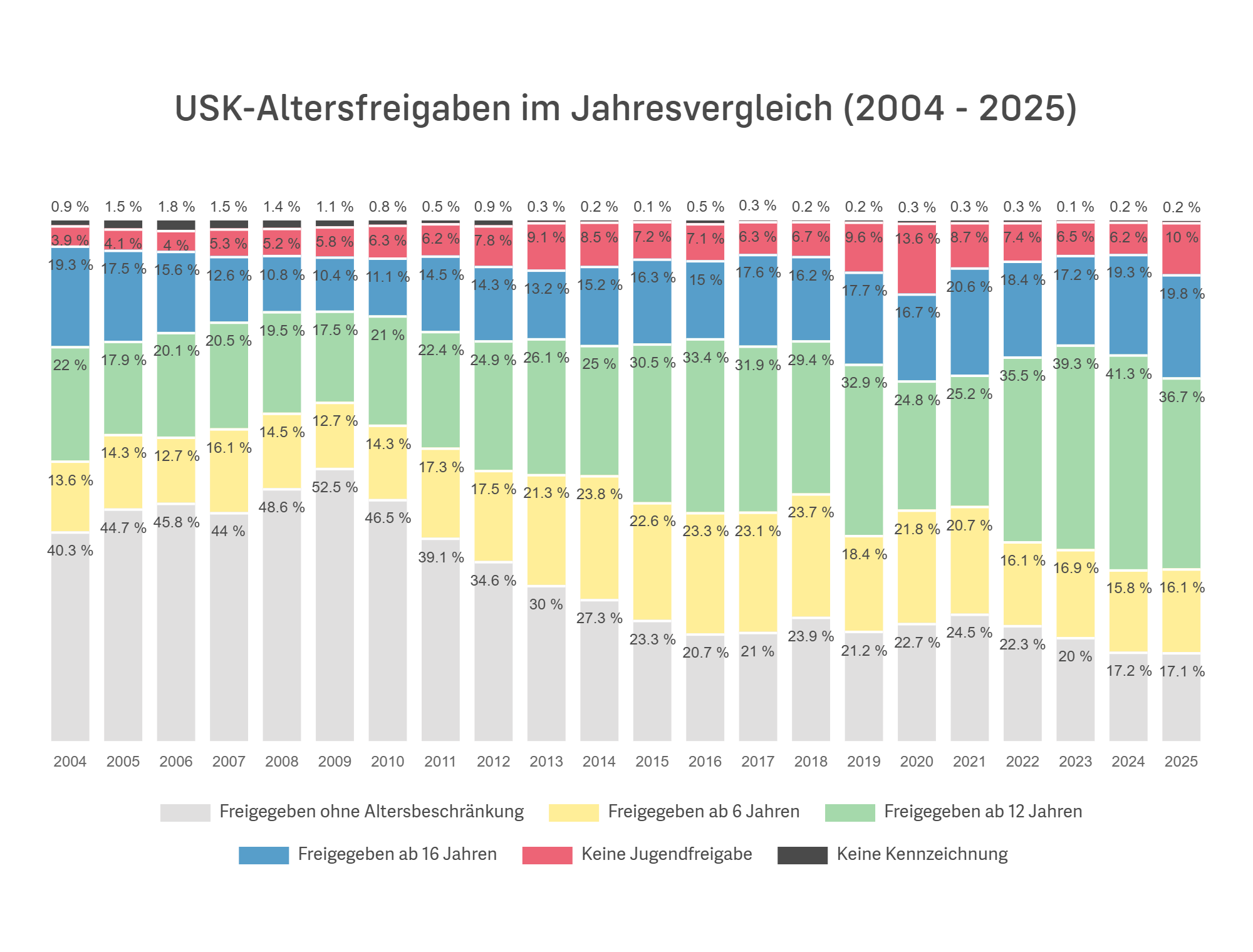
The USK statistics for the standard procedure reveal an unusually high proportion of games rated 18+. Around 10% of all titles assessed received the ‘Not approved for minors’ (18+) rating. This is the second-highest figure since statistics began in 2004. Only in 2020 was the proportion even higher, at 13.6%. However, it is not possible to say whether this represents a long-term trend. The proportions of age ratings are highly volatile. In 2024, only 6.2% of all titles reviewed received an 18+ rating. This was the lowest proportion since 2011.
Through the automated IARC process, which the USK developed in collaboration with other age-rating organisations, 1.3 million ratings were assigned to digital games. IARC is now used by almost all digital stores and platforms, including the Epic Games Store, the Google Play Store, the Nintendo eShop, the Microsoft Store, the Sony PlayStation Store and Fortnite. In September 2025, Roblox also announced its intention to implement the IARC system. Apple and Steam continue to rely on their own solutions and are not connected to IARC.
Elisabeth Secker, Managing Director of the USK | Picture by Helen Nicolai
"The protection of minors and age limits are currently a major focus of public debate. The good news is that the protection of minors in games has been working reliably for many years. The USK’s age ratings ensure that digital games are reviewed and rated appropriately for their target age group. Combined with technical support tools for parents, this creates effective protection for children and young people. However, to ensure this system remains sustainable and no gaps in protection arise, age ratings from recognised self-regulatory bodies must apply to all market participants. Reliable youth protection requires uniform criteria and quality-assured procedures. The credibility of the USK’s age ratings stems from review panels with diverse membership, in which people from various sectors of society take on responsibility and weigh up each case individually. At the same time, the self-regulation structures enable a flexible and rapid response to new developments in the digital market and allow for the continuous adaptation of their rating practices. For over 30 years, the USK has stood for a well-established, transparent rating practice and is a proven, reliable partner in the protection of minors in the media,” says Elisabeth Secker, Managing Director of the USK.
Stephan Steininger is Director of Operations and Editor-in-Chief of GamesMarket. As part of the magazine since its inception in 2001, he knows the GSA games industry by heart.