Escaping the "Algorithm Trap": Why Gaming Marketers Must Rebalance Brand and Performance

– 4 min read


In today’s hyper-competitive gaming and app landscape, the allure of immediate, trackable metrics is hard to resist. We optimize for clicks, obsess over Return on Ad Spend (ROAS), and pour our budgets into the bottom of the funnel. But are we sacrificing long-term IP health for short-term conversion wins?
I recently explored this tension with Kevin Fryers, a marketing veteran whose career spans P&G, Activision, Warner Bros., and Square Enix. His insights reveal a critical imbalance in how modern entertainment is marketed, an imbalance that recent industry data shows is becoming incredibly expensive to maintain.
Here is why growth leaders need a reality check, and how to fix the broken relationship between brand building and performance marketing.
The gaming industry has become heavily weighted towards performance marketing. As Fryers noted in our conversation, this shift is highly understandable: performance marketing is easier to measure, easier to justify to the broader business, and offers an almost immediate feedback loop.
However, Fryers warns that this creates a dangerous trap. Marketers end up optimizing for what is easy to prove in the present, which comes at the cost of what actually drives long-term demand.
The financial toll of this "Algorithm Trap" is staggering. According to a 2024 report by Bain & Company, gaming companies spend roughly 25% of their total revenue on marketing, significantly higher than the 15% average for other software sectors. Yet, despite this massive spend, growth is stalling because too much budget is misdirected into generic, short-term user acquisition (UA) tactics that fail to build loyalty.
When marketing teams become too reliant on the algorithm, the relationship with the audience becomes entirely transactional. By leaning strictly into the bottom of the funnel, marketers are merely converting intent that already exists, rather than creating new intent.
The math on this strategy is actively breaking down. The cost of buying un-warmed users is skyrocketing. According to Business of Apps (2024-2025 UA Cost Data), the average Cost Per Install (CPI) has reached historic highs, especially for high-value genres and iOS users:
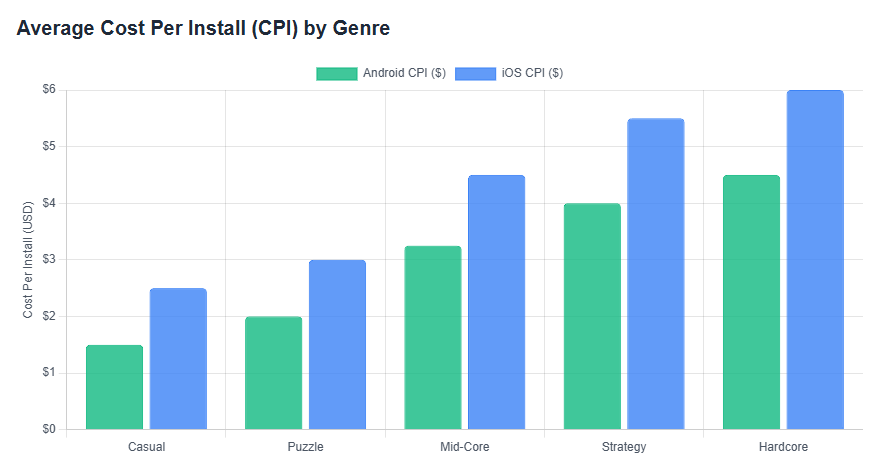
As privacy regulations tighten and channels saturate, buying your way to the top of the charts using performance marketing alone is no longer a sustainable business model.
Fryers notes that the titles that truly break through the noise tend to exhibit strong brand and community signals well before their actual launch. "Brand creates the desire and confidence; performance captures it," Fryers explains.
When early brand momentum is missing, performance marketing is forced to work much harder and operates far less efficiently. While surprise launches can occasionally succeed, there are very few examples of games that can do so at scale, hold their players, and deliver on metrics over time without a foundation of brand equity.
If teams underinvest in the brand side, they are effectively shrinking the pool of players they are trying to convert later on.
Fryers’ experiential insights are perfectly mirrored by cross-industry marketing data. You cannot optimize the bottom of the funnel if the top is empty.
A 2024 joint research report by Tracksuit and TikTok, titled "The Awareness Advantage," quantified exactly how much brand marketing impacts performance efficiency.
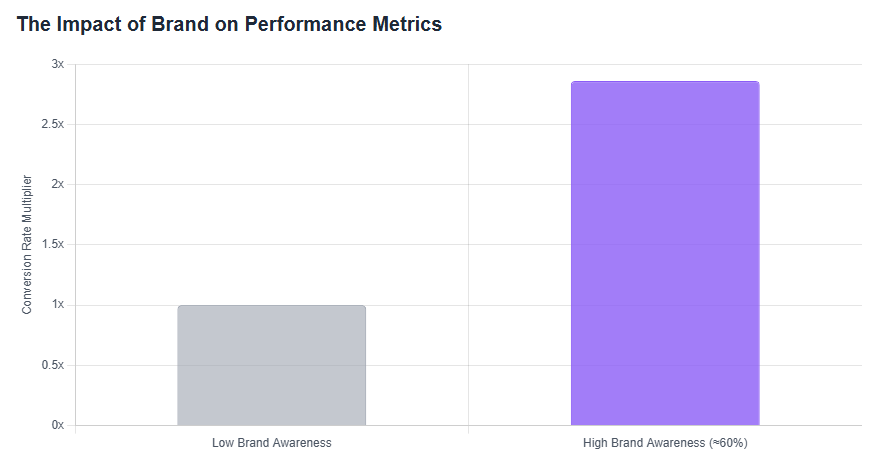
Fascinatingly, the study found that high brand awareness didn't necessarily make people click more in the moment (CTR remained relatively stable); it made them convert more overall. By building familiarity and trust early on, a strong brand reduces the cost per acquisition and makes every dollar spent on performance marketing work harder.
Ultimately, the future of successful publishing isn't a battle of "Brand vs. Performance." It’s about building a synchronized engine.
The industry has become incredibly adept at optimizing the bottom of the funnel, making early top-of-funnel brand investment feel like a much higher risk by comparison. But as the data shows, the real risk is paying a premium to acquire users who have no emotional connection to your game.
It's time to escape the algorithm trap. Invest early, create the desire, and let your performance marketing do what it does best: capture it efficiently.
What is your take on the current balance between brand and performance in your marketing mix? Let me know in the comments below!
Sources
Zoran Roso stands as a highly influential veteran of the video game and entertainment industry, with a distinguished career spanning over 25 years in global publishing, marketing, and leadership roles. His professional journey includes serving in significant executive positions at some of the world's most recognizable gaming giants, including Rockstar Games/Take 2 Interactive, Activision Blizzard, and Sony PlayStation, where he was instrumental in the marketing and strategic positioning of flagship AAA franchises and brands. Most recently, he leveraged this extensive experience as the Global Publishing & Marketing Director at Tencent Games, a critical role focused on expanding the company's international reach and developing successful go-to-market strategies for its massive portfolio of internal and partner studios.
Now operating as the founder of ZR Consulting, Zoran continues to drive success in the industry by advising major global publishers and developers. His firm specializes in crafting winning strategies for international brand development, optimizing live service performance, and executing flawless launch plans across all major platforms, including console, PC, and mobile. An active figure in the global games community, his career is marked by a clear strategic vision and a successful track record in translating complex products into global commercial successes.
Contact details:
ZR Consulting
eMail: zoran.roso@zrconsulting.de
LinkedIn: https://www.linkedin.com/in/zoran-roso/